Thursday, July 17, 2014

Chazzans are fools

Apparently there was some kind of rabbinic stereotype that chazzans were idiots. I found two jokes relating to that:
1: It was once asked to a sage as to why it is that the chazzan makes kiddush in shul Friday night, but does not make havdala Saturday night? He answered: Have you not seen the Jerusalem Talmud "אם אין דיעה הבדלה מנין"
[That line happens to be the opinion in the Talmud that says "ata chonen" should be said on Shobbos]
2: It was once asked to a sage as to why everyone says that Chazzans are idiots? He answered: We know that if a chazzan makes a mistake, it is a bad sign for the congregants. And we also know that the rule is that if someone sends a shoteh for a sinful act, the sender is at fault. We see that a chazzan has a chazaka of an idiot.

"Moses wrote the section of Bilaam"

So says TB Bava Batra 14b:

 ומי כתבן משה כתב ספרו ופרשת בלעם ואיוב
 Who wrote them? Moses wrote his own book and the portion of Balaam and Job.
 This is an altogether strange passage, and it is difficult to ascertain whether this refers to an editorial process or the actual composition. Certainly the books that are attributed to the Men of the Great Assembly in the next passage seem to be referring to the final redaction of those books, such as the 12 Prophets, and not their actual composition. It says David wrote Psalms, yet it also says he included other works in it.

Arnold Ehrlich, the 19th century koifer, suggests that Moses used a book available at that time and wrote it into his Torah. Here are his words on Numbers 24:24, as a footnote to his suggestion that Balaam's prophecies were very old, and the involvement of Balak was written in later for various reasons. For Balaam's nation and Balak's nation are adversaries - why would Balak go to Balaam, an enemy?

והוא שאמרו הראשונים משה כתב ספרו ופרשת בלעם (בבא בתרא י״ד ע״ב) הרי שלפי הקבלה פרשת בלעם כתובה בתורה מעל ספר אחר; שאם לא כן מה ספרו ופרשת בלעם שאמרו והלא פרשת בלעם מן ספרו ?ורק על פי מה שאמרתי יפול במאמרם הלשון הזה.
 And that is what the early sages said, Moses wrote his book and the portion of Balaam (Bava Batra 14b), for it was a tradition that the portion of Balaam written in the Torah came from a different book. If this weren't so, what does "his book and the portion of Balaam" mean? Isn't the "portion of Balaam" part of "his book"? It is only according to what I have said that their statement's phraseology can be understood.
R. Abraham Joshua Heschel suggests the same thing in his "תורה מן השמים באספקלריה של הדורות", page 455.

However, the parallel line in Yerushalmi Sotah 5:6 indicates to me something very different:

משה כתב חמשה ספרי תורה וחזר וכתב פרשת בלק ובלעם וכתב ספרו של איוב
Moses wrote the five books of the Torah, and then went back and wrote the portion of Balak and Bilaam, and he wrote his book of Job.
This indicates that the meaning of the line is that he wrote it out of order, not that it came from a different source.

Interestingly, the version of Yerushalmi I have has an alternate version of this line that says that "Moses wrote the fifth book, and then went back and wrote the portion of Balak and Bilaam." Meaning, the fifth book is Deuteronomy, and not all of the Torah. Indeed, some versions of the Sifre on Deuteronomy explicitly state that "Moses wrote his book" means Deuteronomy. As we know, Deuteronomy is widely recognized in Chazal as having been originally generated by Moses with God's approval, and so it might be saying that Balak and Bilaam was also originally generated by Moses and included with God's approval.

Rav Menachem Mendel Kasher actually suggests the opposite, that since people might suspect that it was written by Moses himself without prophecy, the emphasis was that both were written with prophecy, an idea he got from the Chatam Sofer, Shu"t YD 356, who noted that unlike the rest of the Torah that could be handed down as tradition that everyone witnessed, nobody could pass down the story of Bilaam. Yet, anyone who denies its place in Scripture is a koifer, says the Chatam Sofer. So the Talmud wanted to emphasize its place in Scripture.

But actually, the same idea is already found in the Ralbag at the end of Parshat Balak:

וקודם שנזכור התועלות המגיעות ממנה נזכיר ספק אחד בענין זאת הפרשה, והוא: איך נזכרה נבואת בלעם וסיפור דברי בל עימו בתורה? כל שכן שיתחזק זה הספק מצד מה שמצאנו שכבר היה בלעם קוסם

ונֹאמר שכבר נזכרה זאת הפרשה בזה המקום מצד התועלות המגיעות ממנה, כי כבר יתבאר ממנה עוצם השגחת ה' יתעלה על ישראל, כמו שביארנו. ולזה אמר הנביא: 'עמי זכר נא מה יעץ בלק מלך מואב, ומה ענה אֹתו בלעם בן בעור מן השטים עד הגלגל' (מיכה ו, ה). ובה גם כן תועלת להודיע מה היתה הסיבה בזניית ישראל אחר העריות ואחר עבודה זרה, ולמה נצטוו ישראל להרוג את המדינים. וראוי שתדע שאלו הסיפורים מבלק ובלעם ידעם כולם משה רבינו ע"ה מפי הגבורה, ולא נודעו לו על צד הפרסום, כי בזולת זה לא היה ראוי שיִכָּתבו בתורה. הנה כמו שהגיד משה מפי הגבורה דבר הסיפורים שבאו בספר בראשית, כן הגיד זה הסיפור אשר בזה המקום מפי הגבורה. ומזה האופן נתאחדו הסיפורים עם המצוות בתורה, לפי שהם כולם מכוונים להביא אל השלמות האנושי — הנמשכים לדברי התורה. ואל זה כיוונו ז"ל באומרם שמשה כתב פרשת בלעם.


Why does the Yerushalmi say it as "he went back"? Interestingly Rav Kasher points out that there was a prominent rabbi, the Rashban, Rav Shlomo Tzvi Shick, who suggests that the meaning is that Moses wrote it, but it was only included into the Torah proper after the people of Israel already settled the land of Israel. Rav Kasher doesn't accept this and is upset Rabbi Shick would just ignore the 8th principle of Maimonides. Rav Kasher instead suggests it is in accordance to the opinion who says the Torah was written a scroll (megillah) at a time, piecemeal. So it just means that after all the other scrolls were written, did Moses write the section of Bilaam.

It appears as if most were unaware of this passage in the Yerushalmi, or ignored this simple meaning. Korban HaEda just quotes Rashi from the Bavli, who wrote:
ופרשת בלעם. נבואתו ומשליו אף על פי שאינן צורכי משה ותורתו וסדר מעשיו:
And the portion of Balaam: His prophecies and proverbs, even though they aren't [about] Moses' needs, his Torah [laws], and the stories of his actions.
I'm reading this in two very different ways.

Either Rashi is saying that the hava amina is that Moses did not compose it, because its not about him or his laws. Or Rashi is saying that he didn't have to include it in the editorial process, since it isn't about him or his laws, so one would question why he included it in the Torah at all. Both have different answers, implied. For the first, the Talmud is teaching us that Moses did indeed write it, nevertheless. Why? Rashi doesn't go that far here. For the second, the Talmud is teaching us that Moses included it nevertheless. Again, no clue as to why.

Rabbeinu Gershom, on the page, is also perplexing:
ופרשת בלעם. אע"ג דבלעם גופיה הוה נביא
And the portion of Balaam: Even though Balaam himself was a prophet.
This one seems to be clearer, and it is an outright rejection of the conclusion Ehrlich came to about this passage in the Talmud. Rabbeinu Gershom is saying the hava amina is that Balaam would have written his own prophecy, because he was a prophet. The Talmud therefore teaches us that Moses composed this portion himself.

Still, I could see someone reading this  line as saying that Moses included this portion, even though the portion was written by another prophet, Balaam.

The Ritv"a has the most interesting answer I have found in the rishonim. He suggests that a book of Balaam's prophecies existed in the time of Chazal, and that is the book they refer to when they say Moses wrote it. For him, it does not refer to any portion of the Torah. Here are his words, written in his Chiddusim to Bava Batra 15a:

והא דאמרינן לעיל במשה שכתב ספרו ופרשת בלעם נראין דברי האומרים שאין זו פרשת בלעם שכתובה בתורה דההיא הקב"ה כתבה כשאר התורה אלא פרשה בפני עצמה היא שכתב והאריך בה יותר והיתה מצויה להם 
That which we said earlier that Moses wrote his book and the portion of Balaam, it seems [correct] according to those that say that this is not the portion of Balaam written in the Torah, for that was written by God, like the rest of the Torah, rather this refers to a separate portion that [Moses] wrote, which was much lengthier [than the portion in the Torah], and they possessed it.
Perhaps a source to bolster this idea is the line in Sanhedrin 106b that there existed a certain "notebook" of Bilaam, which seems to indicate that like the Chronicles of Moses and other such books, there was also a Chronicle of Bilaam:
דידי חזי לי פנקסיה דבלעם והוה כתיב ביה בר תלתין ותלת שנין בלעם חגירא כד קטיל יתיה פנחס ליסטאה
I personally have seen Balaam's Chronicle, in which it is stated, 'Balaam the lame was thirty years old when Phinehas the Robber killed him.' 
Ibn Shuib writes similarly in his derashot to Parashat Balak:

ואין ספק כי הכתובים קצרו ענין בלעם ונבואותיו לישראל לפי שעה, וגם קצר הכתוב בענין חכמת קסמים כמו שקיצר בענייני ע"ז של דור אנוש שלא סיפר בו הכתוב כלל, וחבר בו אברה' אבינו ע"ה ספר שהיו בו ת' פרקים כמו שאמרינן ע"ז דאברהם אבינו ארבע מאה פרקי הוו. ובכאן קצר ענין בלעם... ונראה מדעת רבותינו ז"ל כי משה רבינו ע"ה חבר ספר לבד מה שהוא כתוב בתורה, והיה שם סיפור פרשת בלעם כמו שאמר, משה כתב ספרו ופרשת בלעם וספר איוב, ורחוק הוא שנפרש פרשת בלעם על הפרשה הזאת הכתובה בתורה כי בכלל ספרו היא והיא מכלל התורה, אבל היה ספר בפני עצמו ונאבד כמו שנאבדו ספרים אחרים מכלל ארבעה ועשרים ספרים המקודשי' ובכאן בתורה ספר הענין בקוצר.
Undoubtedly, Scripture curtailed the story of Balaam and his prophecies for the Jews according to the time, and it also curtailed the topic of witchcraft, like it curtailed the topic of idolatry in the generation of Enosh which is not described in Scripture at all. And Abraham our father, peace be unto him, wrote a book of 400 chapters about it, as we say, (Avodah Zara 14b) "The idolatry of Abraham contained 400 chapters." And here, the topic of Balaam is curtailed... And it seems [to be] of the opinion of our sages, may their memory be a blessing, that Moses our teacher, peace be unto him, wrote a book apart from that which is written in the Torah, and the name of that book was "Parshat Bilaam", as is said, "Moses wrote his book, Parshat Bilaam, and the book of Job. And far-fetched is the interpretation that "Parshat Bilaam" refers to the portion that is written in the Torah, for that is included in "his book", both included in the Torah. Rather it was a book unto its own, and it was lost, just like other books were lost from the 24 holy books [of Tanach], and here the Torah tells it over in an abridged form.

Ibn Shuib refers to several midrashim that I am not aware of, so explanations of some of this will have to wait.

If the Ritv"a and Ibn Shuib are correct, they may have been referring to this prophecy and others:

Deir Alla inscription: 

McCarter's translation and reconstruction of the text:
(1) [VACAT] The sa]ying[s of Bala]am, [son of Be]or, the man who was a seer of the gods. Lo! Gods came to him in the night [and spoke to] him (2) according to these w[ord]s. Then they said to [Bala]am, son of Beor, thus: Let someone make a [ ] hearafter, so that [what] you have hea[rd may be se]en!" (3) And Balaam rose in the morning [ ] right hand [ ] and could not [eat] and wept (4) aloud. Then his people came in to him [and said] to Balaam, son of Beor, "Do you fast? [ ] Do you weep?" And he (5) said to them, "Si[t] do]wn! I shall inform you what the Shad[dayin have done]. Now come, see the deeds of the g[o]ds!. The g[o]ds have gathered (6) and the Shaddayin have taken their places in the assembly and said to Sh[ , thus:] 'Sew the skies shut with your thick cloud! There let there be darkness and no (7) perpetual shining and n[o] radiance! For you will put a sea[l upon the thick] cloud of darkness and you will not remove it forever! For the swift has (8) reproached the eagle, the voice of vultures resounds. The st[ork has ] the young of the NHS-bird and ripped up the chicks of the heron. The swallow has belittled (9) the dove, and the sparrow [ ] and [ ] the staff. Instead of ewes the stick is driven along. Hares have eaten (10) [ ]. Freemen [] have drunk wine, and hyenas have listened to instruction. The whelps of the (11) f[ox] laughs at wise men, and the poor woman has mixed myrhh, and the priestess (12) [ ] to the one who wears a girdle of threads. The esteemed esteems and the esteemer is es[teemed. ] and everyone has seen those things that decree offspring and young. (15) [ ] to the leopard. The piglet has chased the young (16) [of] those who are girded and the eye ....'"
And in Rav Yaakov Kaminetzky's Emet LeYaakov, beginning of Parshat Matot, he theorizes that all prophets filtered their prophecies through their personalities and psychology, which was not true for Moses, who did not have any filtering process - it was literally the word of God. This is what made Moses special as a prophet. And we know that Bilaam was seen as Moses' equal in prophecy - the Sifre end of Vezot HaBeracha says this explitly.

If so, says Rav Yaakov, Bilaam's story and prophecy did not come from Moses - it came from Bilaam, which came unfiltered from God. If so, he states, all Moses did was take Bilaam's story and put it in the Torah.

One last note, an interesting suggestion by the Sefer Megaleh Amukot Parshat Vatechanan 118 is that "the portion of Balaam" refers to the 18 verses in Joshua that speak of the war with Midian and Balaam's death.

And I'm also finding that Rav Tzadok MLubin understands this passage as meaning that the portion of Balaam did not find expression from the Godhead within Moses' brain, unlike the rest of the Torah, so it specifies he wrote it. What this means is that the words of Balaam's prophecy did not come from Moses himself. Indeed, at least one way of reading Rashi is like that, and perhaps Rabbeinu Gershom. Maharil Diskin does ask on Rashi how he could go against the passage in Chelek that states that one loses their portion for claiming even one word does not come from Moses. First, its not necesarily a question if Rashi only speaks of hava aminas. But secondly, the line in the gemara is really about Moses coming up with it on his own, and ostensibly Rashi believes Balaam's prophecy came from God, so its still valid to go in the book. Maharil Diskin also disagrees with the Ritva for stating that it refers to a compeletely different book, because it seems like all the books mentioned are in the canon, and this book is not. However, if you see above, Ibn Shuib actually answers that critique by stating that it was part of the canon, along with many other books that were lost!

Monday, June 30, 2014

Choni Hamagil Today

Taanit 23a:

One day he [Honi the Circle Drawer] was journeying on the road and he saw a man planting a carob tree; he asked him, How long does it take [for this tree] to bear fruit? The man replied: Seventy years. He then further asked him: Are you certain that you will live another seventy years? The man replied: I found [ready grown] carob trees in the world; as my forefathers planted these for me so I too plant these for my children. Honi sat down to have a meal and sleep overcame him. As he slept a rocky formation enclosed upon him which hid him from sight and he continued to sleep for seventy years. When he awoke he saw a man gathering the fruit of the carob tree and he asked him, Are you the man who planted the tree? The man replied: I am his grandson. Thereupon he exclaimed: It is clear that I slept for seventy years.

Tuesday, June 10, 2014

The Onkelos-Anthropomorphism Debate And Shadal’s Third Approach

The intended audience and motives of a translation are usually closely connected for any translation for the public. If the translation is accurate and consistent, one can attempt to discern the concerns of the translator through the choices made. Onkelos, the ancient translation of the Pentateuch, should not be an exception to this rule. Yet, it has continued to perplex interpreters of Onkelos as to how to understand the reasons for seeming inconsistencies in its translation, and Onkelos’ motives as a translator. In medieval rabbinic discourse (and to some extent, today’s rabbinic discourse), there is an even stronger need to detect Onkelos’ school of thought. Traditions of Onkelos’ origins place the translator in the same time-frame as important Talmudic rabbis and even interacting with them, making Onkelos an almost “Chazal-sanctioned” translation. Thus, the identification of Onkelos’ school of thought becomes most important to the rabbis as they equate Chazal with Onkelos’ translation.1 One major rabbinic debate, the question of Onkelos’ purpose in the sometimes inconsistent anthropomorphic changes of the translation, represents an interesting example of this need.
Maimonides, in his Guide for the Perplexed (1:27), writes:
Onqelos the Proselyte was very perfect in the Hebrew and Syrian languages and directed his effort toward the abolition of the belief in God’s corporeality. Hence he interprets in accordance with its meaning every attribute that Scripture predicates of God and that might lead toward the belief incorporeality. Thus whenever he encounters one of the terms indicative of one of the kinds of motion, he makes motion to mean the manifestation and appearance of a created light, I mean the Indwelling or the action of providence. Thus he renders, [Exodus 19:11] The Lord will descend, by the words, The Lord will manifest Himself; [Exodus 19:20] And the Lord descended, by the words, And the Lord manifested Himself. He does not translate: And the Lord came down...This occurs continually in his interpretation.2
Maimonides, a Judeo-Aristotelian, read Onkelos as sharing a similar philosophical view as to God’s incorporeality. Similarly, as stated in Guide 1:48, Onkelos never translates “hearing” literally, but rather that the matter “reached” God.
Maimonides (Guide 1:27) does deal with one inconsistency, that of Genesis 46:4, I will descend with thee into Egypt, which is translated literally. He declares that it is unnecessary to protect against anthropomorphic mentionings occurring in dreams, as is the case here, because these are not “matters having existence.”3 Thus, he sees Onkelos as writing for both the wise and the masses, supporting the appropriate views for the learned, and removing incorrect views from the unlearned. He states this explicitly in Guide 1:36:
I do not consider as an infidel one who cannot demonstrate that the corporeality of God should be negated. But I do consider as an infidel one who does not believe in its negation; and this particularly in view of the existence of the interpretation of Onqelos and of Jonathan ben Uziel, may peace be upon both of them, who cause their readers to keep away as far as possible from the belief in the corporeality of God.4
Again, to Maimonides, a translation written to enforce and reinforce correct ideas about God, does not need to change the literal verse when people would not make the mistake of misunderstanding God’s incorporeality.
Nachmanides, in his commentary to Genesis 46:1, mounts a formidable argument against Maimonides interpretation of Onkelos. His objections can be distilled into five categories:
  1. Cases where sometimes Onkelos translates an action of God literally, yet other times changes it from its literal meaning. For example, Maimonides spends much time praising Onkelos on his changes to the word “hearing”, yet “speaking”5 and “seeing”6 in reference to God have many cases where they are translated literally. Rather, Nachmanides posits, just as “hearing” can mean “understanding”, so do “seeing” can denote understanding, and Onkelos is consistent when the Pentateuch uses it to mean God’s discernment and when it doesn’t. Additionally, sometimes Onkelos will paraphrase God “passing over” something, as in Exodus 34:6, and other times will translate literally, such as Nachmanides’ version of Deuteronomy 31:3.
  2. Cases where Onkelos translates a corporeal reference to God’s “body” literally, such as Exodus 31:18, without apparent fear of corporeality, such as Exodus 14:31 “the great hand”, or Deuteronomy 33:2, “at His right hand was a fiery law.” Additionally, Onkelos translates God “standing” literally.
  3. Cases where sometimes Onkelos translates non-literally even for events occurring in dreams, contra Maimonides who says that dreams and visions are reasons for Onkelos translating literally.
  4. Cases where there is no fear of corporeality, yet Onkelos changes it anyway to distance it from God. Nachmanides posits that “their secret meaning is known to the learned student [of the mystical law of the Torah].”
  5. Cases where sometimes Onkelos translates the motion of God non-literally as the “Divine Presence”, and other times translates it literally. Again, Nachmanides posits that “All these subjects [...are not influenced by a fear of using terms denoting corporeality but rather by secrets] of the Cabala known to Onkelos…”

Some defenders of Maimonides found it necessary to bring him closer to the thought of Nachmanides to answer these questions. Rabbi Yom Tov ben Avraham Asevilli (1250-1330), known as the Ritva, was a follower of the school of Nachmanides, as a student of the Ra’ah, a student of Nachmanides himself. Even so, he composed a book, Sefer HaZikaron, in defense of Maimonides for most of the places where Nachmanides argues against him in his commentary on the Pentateuch.” Whereas Nachmanides states that the reason for seeming inconsistencies for the most part is because of Onkelos’ knowledge of Kabbalah, Ritva posits that Maimonides believed Onkelos had knowledge of the “Work of the Chariot”, Maaseh Merkava, and used it as part of his translation. This being so, Maimonides also writes in his introduction to the Guide that Maaseh Merkava should only be expressed by way of flashing hints (which is his solution to the Mishnaic dictum not to discuss this with students more than one at a time, and even then, only chapter headings), and this is the purpose of the confusing inconsistencies found in Onkelos. As he writes, “If he would have translated everything in one way and with a single intention, he would have revealed the secret, and in another way, he would have completely hidden it. It is better regarding secrets that they be revealed in one in one aspect, and hidden in another.”7
So then what is Onkelos’ intended audience? While Nachmanides thinks the intended audience of Onkelos includes the kabbalist will understand the true reasons for the different translations, for the Ritva’s Maimonides, it is the philosopher. Both might allow for the surface meaning to be intended for the masses as well. But, as I wrote above, Maimonides himself definitely believed Onkelos was for both the learned and the unlearned.
Enter Rabbi Samuel David Luzzatto (1800-1865), known by the acronym Shadal (which he called himself in his lifetime), an Italian mixture of traditional and “enlightened” Jew. He could be said to be “stuck” in this case. For he believed on the one side that Maimonides’ drawing on Aristotelian philosophy was incorrect and hurtful to Judaism, and on the other, kabbalistic mysticism was not authentic. In his commentary on the Torah to Exodus 20:2, he writes, “Thank God that we have been exempted from that philosophy that was in vogue in his days, which Maimonides was inclines towards too much, even if his intentions were good,"8 echoing the formula pronounced by a father at his son’s bar mitzvah for God having removing his son’s spiritual responsibility from him. This is in the context of disputing Maimonides enumeration of belief (specifically belief in God in this case) as part of the commandments. Shadal also wrote an essay in the periodical Kerem Hemed 3 (1838): 61–76, criticizing Maimonides concept of the soul for, among other things, being drawn straight from Aristotelian philosophy. He discontinued his friendship with Rabbi Solomon Judah Rapoport partly because of that essay. He wrote a book on Jewish belief called “Yesodei HaTorah”, an obvious attempt at replacing Maimonides’ “Yesodei HaTorah”. In these ways and many more, Shadal is considered an “anti-Maimonidean”.9 He was also against kabbalistic mysticism, penning a pamphlet while still unmarried at 28, pointedly titling “Vikuach al Chochmat HaKabbalah”.10
So what was Shadal to do in writing a book about Onkelos? After all, he called it “Ohev Ger”, his love for Onkelos starting when he first discovered a rare manuscript of Onkelos at 13. He could never allow Onkelos to be an Aristotelian, nor a secret kabbalist. Instead, he discerned a third approach. This is almost at the very beginning, after he declares that most will not accept this truth he will now lay out:
The Targum was not made for the scholar, but for the layman. The main intention of Onkelos in his translation was to remove all stumbling blocks from before the masses, and from before the converts, so that their listening to the recitation of the Torah would be beneficial to them, and not damaging, God forbid. And without it, shallow-minded people would be able to find something in the holy Torah that is loathsome to them, and they will not ponder it in their shallow minds; they will cause an iniquitous stumbling block in whichever way it will be [interpreted], or they’ll cause the honor of the Torah to be insignificant in their eyes, allowing scornful people a context in which to mock it, God forbid. It was also for the gentiles, so that it won’t be distant to them, if their hearts lift them to come to take refuge under the wings of the Shechinah. Along with that, it was also to prevent the nation from being an object of mockery and scorn in the eyes of the gentiles, if they find things in our Torah and in the narratives of our forefathers that are not honorable and glorious in their eyes.

So, there are three audiences in mind. One is the unlearned masses and converts, who need a translation that will not take away from the glory and majesty of the biblical characters, including God. Two is those who seek to mock Judaism, to lessen their ability to do so by protecting the biblical characters. And third are for the gentiles (quite an extraordinary claim that an analysis of exceeds the scope of this paper), which is also to protect Jews from mockery as well as to make the stories acceptable so that it won’t make gentiles run away from converting because of the strange stories.
His book is made up of 32 “paths”11 to understanding Onkelos’ changes in translation, along with numerous examples for each category. His third path is:
“...when Onkelos changes the words out of concern for God’s honor, removing any mention of imagery with regards to Him, and any actions [by Him] or actions toward Him, which have the effect of lessening God’s honor in the hearts of the masses… Onkelos did not flee from any mention of anthropomorphism, unless it was the kind that would cause people to view God with less respect. Even though the figure of speech of ‘the finger of God’ is anthropomorphic, it stays well with those who hear it. Instead of being damaging, it is actually beneficial, to raise up the glory of the Torah… Nachmanides, already, occupied himself with Maimonides’ opinion that Onkelos tried to remove all physicality in regards to God... [Shadal proceeds to list a dozen verses that could be brought for Onkelos’ literal translations of God’s anthropomorphism]… While Nachmanides answered for Onkelos by way of sod [kabbalah], we can go according to what we have said very simply, we do not have to veer right or left, we can just say that Onkelos did not feel the necessity to change the language of Scripture when these figures of speech only enhance and elevate the glory of God in His abilities and providence, and do not lower His glory, God forbid, in the eyes of the masses.”
Shadal certainly has an interesting theory, but does it hold up to the inconsistent verses? It is difficult to imagine why (Exodus 19:11), “The Lord will descend,” takes away from the glory of God so much so that Onkelos translates it as, “The Lord will manifest Himself,” yet His promise to Jacob, (Genesis 46:4), “I will descend with you,” did not, and is therefore translated literally. The explanation is insufficient to explain every detail. Presumably, it takes a great deal of subjectivity to determine if something would “take away from the glory of God for the masses”, and that is the weakness of this approach.12
---
1 Some academics, in contrast, place Onkelos squarely outside of Pharasaic theology. Daniel Boyarin, for example, in Border Lines: The Partition of Judeo-Christianity (Philadelphia: University of Pennsylvania Press) 112-127, argues that Onkelos’ frequent use of “memra” - “the word”, is evidence of the “pararabbinic” doctrine of Logos theology, which has a major place in early Christian thought (as seen in the Prologue to the Gospel of John), but is also found in the Jewish Platonist Philo as well. Boyarin’s argument, as he states explicitly, relies on the presumption that the people of the synagogues had vastly different beliefs than the rabbinic elite of the time. Other scholars, such as Avigdor Shinan (“Live Translation: On the Nature of the Aramaic Targums to the Pentateuch,” Prooftexts 3 (1983) 44), argue that Onkelos and the targumim represent a version of rabbinic thought that was engineered so as to be easily understood to the layman. These will be interesting in comparison to Shadal’s view which will be analyzed.

2 Translation Pines ed. Vol 1 pg 57

3 Ibid. 58. This fits into Maimonides’ understanding of angels. To Maimonides, any mentioning of angels taking on form in the Bible necessarily occurring in dreams, since angels cannot take on form in existence. Even though angels cannot be physical, he says, the Bible makes it seems so because they occur in dreams, and one can understand that something that is not actually happening can be talked about this way. This concept, too, is debated by Nachmanides on Genesis 18:1, and one cannot help but wonder if they are connected concepts.

4 Both Arthur Hyman in “Maimonides as an Exegete” and David Shatz in “The Biblical and Rabbinic Background to Medieval Jewish Philosophy,” connect this declaration with Maimonides’ categorization of anthropomorphists as heretics in Mishneh Torah, Laws of Repentance 3:7. Hyman sees this as a “response” to the opinion as expressed in the gloss of Abraham ben David (the Raabad) on that statement: “People greater and better than he have followed this opinion, based on what they saw in scriptural texts and in the words of the Aggadah, which corrupt opinions.” To Maimonides, the existence of the Targumim such as Onkelos negate that allowance, because people could trust the Targumim. Nachmanides’ disagreeance, as we shall examine soon, would also have an impact in this area as to how to categorize an anthropomorphist, since to him, people do not have the Targumists to rely on for correct philosophical opinions.

5 In the Guide 1:65, Maimonides might have provided reasons for this exception. “Now in all cases in which the words saying and speaking are applied to God… they are used to denote either will or volition...The terms in question never signify that He, may He be exalted, spoke using the sounds of letters and a voice...As regards volition and will being denoted by the word saying and speaking… [this is] because these words are equivocal...They are used by way of likening Him to us. For...man cannot understand at first how, where there is a will that a thing be done, that thing should be done by the mere will alone.” In other words, “saying” does not indicate actual verbal speech, and even were Onkelos to change the phrase to be “God wished” or some other phrase such as that, it would still be just as confusing to people in terms of what caused what. When speaking to prophets, however, Maimonides explains that God’s “speech” is meant to signify that a prophet understands His will, not that they produced the thought themselves. Since these occur in people or the world, and not in God, it is unnecessary to change them. See also Guide 1:21.

6 In Guide 1:48, Maimonides chalks up some of these exceptions to scribal errors.

7 http://www.hebrewbooks.org/pdfpager.aspx?req=40011&st=&pgnum=43&hilite=

8 וברוך המקום שפטרנו מאותה פילוסופיאה שגברה בימיו אשר נטה אחריה הרמב"ם יותר מן הראוי גם כי לטובה היתה כוונתו. Shadal explained what he means by those last few words “his intentions were for good” in the Vikuach, that medieval sages only became interested in philosophy because people were leaving Judaism in the pursuit of it. As a stop-measure, the rabbis such as Maimonides wrote reconciliations of the two studies. Interestingly, Rabbi Abraham Isaac Kook would write something very similar only a generation or two later, in L’Nevuchei HaDor chapter 2 (recently published by Yediot Acharonot), where he also claimed that it was the responsibility of the rabbis in our own generation to follow the strategy of the medieval scholars who saw their youth following after non-Jewish studies, and write new books reconciling the new ideas in his own times. Edit: I thought this was revlatory, but now I see in Nachmanides' letter to the French rabbis disagreeing with their protests of Maimonides, he claims that Maimonides saw people leaving the path for philosophy and science, and that is why he wrote his books. Although I have heard this many times about Maimonides' motivations, it seems from his introduction to the Guide that he explicitly was writing his book for those well versed both in Torah and the sciences, studiously learning and keeping the Torah, while having access to the outside world, without explanations for all the contradictions they found.

9 See also his letter to Almeda about Jewish beliefs for more relevant information about this, http://www.hakirah.org/Vol%2010%20Klein.pdf

10 A choice quote, “The haughtiness of Yerovam drove him out of the world, and the haughtiness of the kabbalists causes them to choose to deny God, and to say that God is not God, and that Ein Sof is not Ein Sof, in a way that they have no God anymore at all, rather than admitting that there is dispute between their sages, something with is clear like the sun at noon.” Translated here http://parsha.blogspot.com/2008/05/authenticity-of-kabbalah-pt-xxxii.html

11 “Netivot”, which may be a reference, or even a parody, of the 32 netivot mentioned in Sefer Yetzira.

12 An interesting note: In his flight from Maimonides, Shadal still agrees with one of his premises: Onkelos intended to protect people from erroneous understandings of Scripture. Nachmanides is properly disagreeing; there is nothing similar about their approaches. Another approach, as seen in Maharal Tiferet Yisrael 33, is that it cannot be that the verse as translated literally would be made in a way to cause man to have erroneous ideas. Rather, when a verse mentions God “going down”, it means that that is literally how Israel experienced it, and the Torah speaks from the perspective of man’s experience of events (see Rav Kook on the creation story, as well). Why, then, did Onkelos differ? Because, while the Torah can speak however it would like in its references to God, Onkelos felt a need to be more respectful than that. Since I have looked at this inside, it remains to be seen how he deals with exceptions.

Monday, June 9, 2014

Shot Analysis of a Scene from Hitchcock's Rear Window

Confrontation and Defenestration: A Shot Analysis of Hitchcock's Rear Window
The 1954 Alfred Hitchcock film Rear Window tells the story L.B Jeffries (played by James Stewart) who, after breaking his leg on the job as a photographer, must entertain himself while holed up in his apartment by looking out his window into the lives of others. An observer (at least for most of the movie), his life is not affected by the lives of the others he watches. Only at the end, when the world of his window and that of the other windows collide, does he become involved in the story unfolding, and his life even becomes endangered. We reach the climax of the film when he is confronted by the suspected murderer, Lars Thorwald (played by Raymond Burr), who, quite literally, pushes Jeffries out of his own window into the world of everyone else. It pays to give attention to the build-up to this climax, the confrontation itself. There are several shots here which symbolize Jeffries’ transfer from observer to participant, and every detail is related to that transfer.
rearwindow2.jpg

rearwindow.jpg
In the previous scene, Thorwald looks into Jeffries’ window and see Jeffries, a reversal from most of the film. Frightened, Jeffries asks his detective friend, Tom Doyle (Wendell Corey), to come and see the evidence he has, and to hurry. Jeffries looks back at Thorwald’s apartment, but it is dark. He can’t see inside. He gets another call, thinking it’s Doyle, says that he thinks Thorwald has left his apartment, but no one is on the other end. Jeffries realizes that the phone call is from Thorwald, who now knows where he is and that he knows about Thorwald. We wait in anticipation as we hear the thump-thump of Thorwald’s walk up the steps to Jeffries’ apartment. Jeffries struggles to find a spot to hide, but is restricted by his cast. He waits by the window, his only weapon his camera and bulbs, something he only used previously in the film to view through, but not to use to photograph. Now his tool for voyeurism will be his tool of involvement. The light is turned off in the hallway. Thorwald appears at the door.
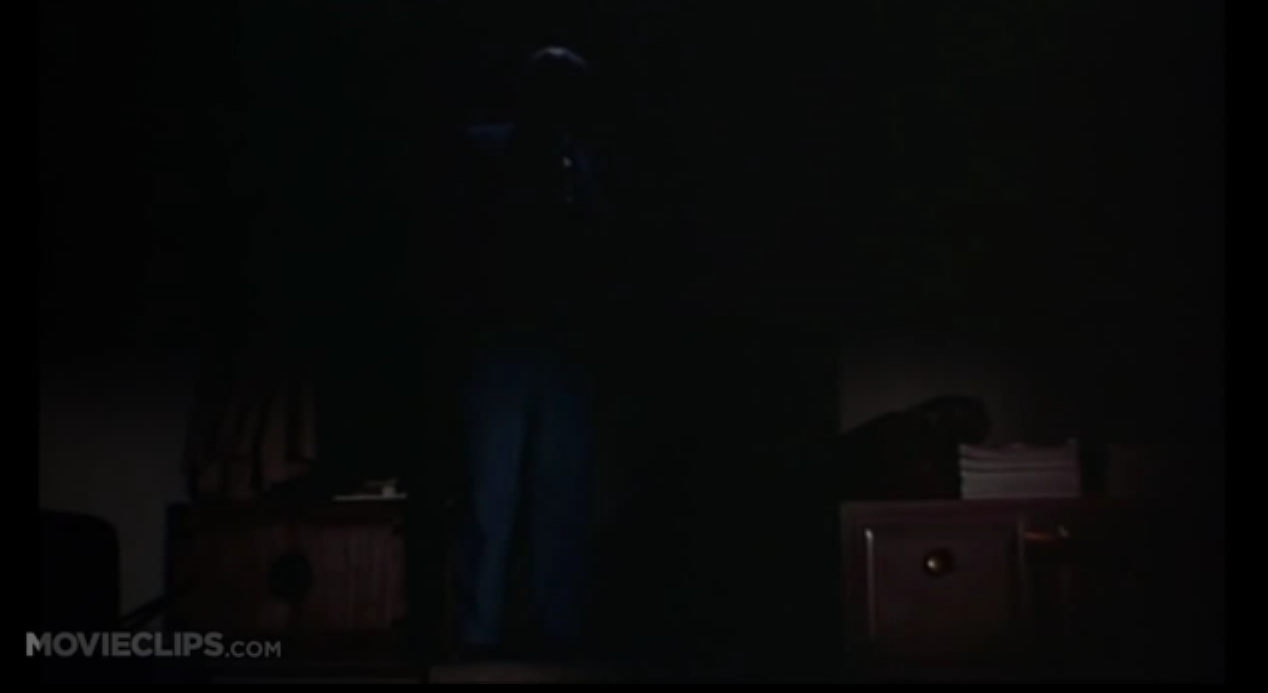
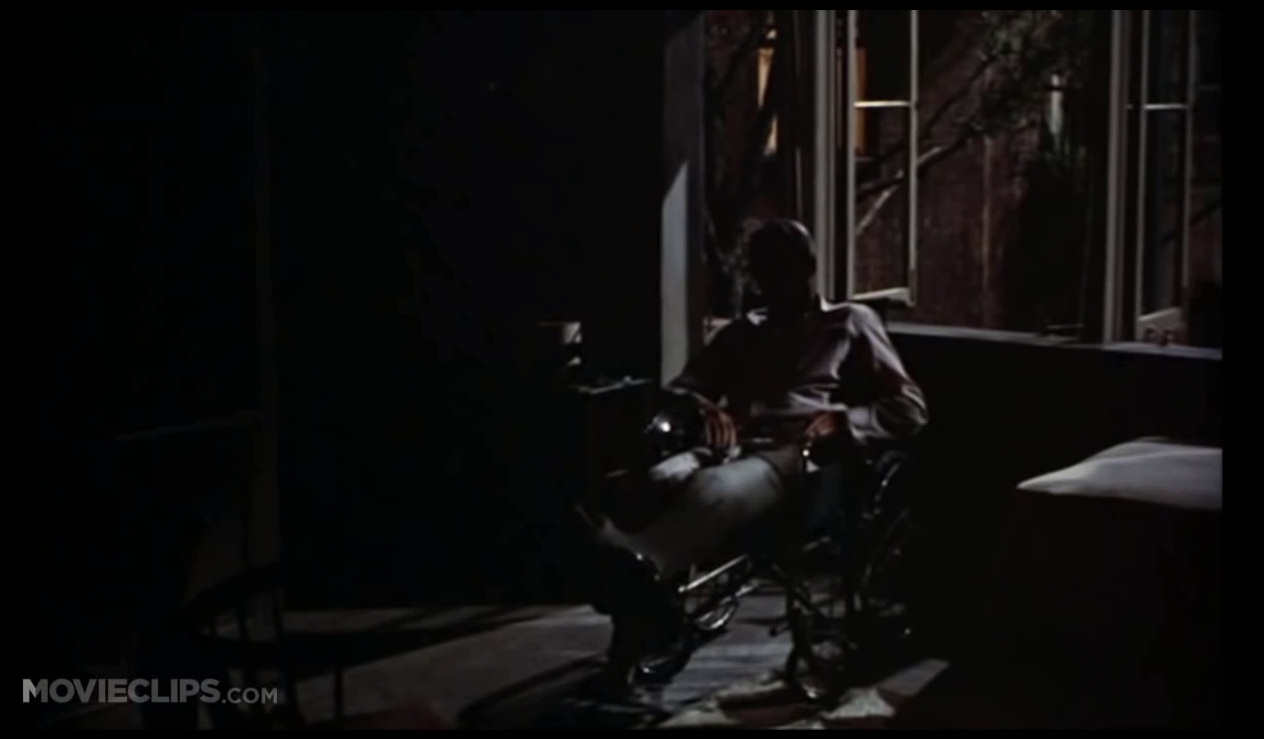
Everything in this scene is a study in opposites. Thorwald stands at the door, his body slightly left of center in the frame, the closed, dark door on his left. We can only see his legs in the light, emphasizing his mobility. We see just a bit of his shoulders, emphasizing his massive frame and his ability to easily crush Jeffries. This is why he takes up so much of the frame. The shot is from Jeffries’ perspective, at the window looking up at the monster at the door. Contrast this to the shot of Jeffries from Thorwald’s perspective from the door. Jeffries sits at the window, his body slightly right of center in the frame, the open, moon-lit window on his left. We can only see his legs in the light, emphasizing his lack of mobility. We see a slight glint of light from his camera, right in the center of the frame. It is his only hope. The shot is from Thorwald’s perspective at the door, looking down at the much smaller Jeffries, who does not take up the frame at all. We, the audience, anticipate a murder about to take place, because the compositions of these two shots are so unbalanced. Lighting is unbalanced, as are the characters in them.
Thorwald stands apart from the door, indicating he is now in the apartment, while Jeffries sits in the area of the frame with the window, foreshadowing his defenestration. His position at the window indicates his wish to remain an observer. However, his back is now to the window, his face to his door. As indicated previously, his camera no longer takes on the role of viewer, but of action. This is reminiscent of the opening scene, when we find out how he got his cast. “I got myself half-killed for ya,” he says to his editor, Gotteson, on the phone, while watching the other people. “And you reward me by stealing my assignments.” The editor protests, “I didn’t ask you to stand in the middle of that racetrack.” Jeffries responds, “You asked for something dramatically different. You got it.” The editor says back, “So did you,” referring to his cast and confinement to his apartment. A bit later, Jeffries says, “If you don’t pull me out of this swamp of boredom, I’m going to do something drastic.” “Like what,” asks Gotteson, as the shot shows Jeffries beginning to view the unhappily married Thorwalds. Jeffries responds by talking about marriage, something he talks about with disdain. The foreshadow is there, indicating his drastic action will involve the Thorwalds. We see several things in that scene for sure, but principal among them is that he got a broken leg in the first place by getting involved with his camera in the middle of something dangerous, a racetrack. And he is about to get a second one by doing it again. This is why the camera takes a center position in the shot.
There is no music, only a howl of wind from the open window. Throughout the movie, music is playing, whether from the pianist or the radio. All of that audio ceases to exist, indicating that all others do not play a role in what happens within Jeffries’ window. Only when Jeffries is being pushed out his window, do all the other neighbors look out theirs. All audio is diagetic. These shots are cuts, which is supposed to be sudden and jarring. In both shots, the actors are still in their respective places, and the camera stays still because it is from their respective perspectives (say that five times fast).
For the shot we are looking at, there is no dialogue. Thorwald says nothing, and Jeffries says nothing. The silence emphasizes the lack of lighting. For Thorwald, the lighting (or lack thereof) is his friend - no one can see him from the other windows as he confronts Jeffries. For Jeffries, the lighting (or, once again, lack thereof) is his friend - his only defense is to momentarily stop Thorwald through the use of his camera flashes. No dialogue occurs as we realize that the scene operates and hangs on the lighting. Eventually, both will be thrown into the light as Thorwald lunges at Jeffries, pushing Jeffries out the window.


Works Cited

Rear Window. Dir. Alfred Hitchcock. Paramount, 1954.

Tuesday, June 3, 2014

Piskei teshuvot on Rebuking Chilonim

A surprising almost Kookian moment from Halacha Sefer Piskei Teshuvos, on rebuking the Chilonim (Shulchan Aruch 608:2):

מצוות תוכחה לחילונים שבימינו 
סﬠי' ב', רמ"א: ואם יודﬠ שאין דבריו נשמﬠים לא יאמר ברבים להוכיחם וכו' אבל ביחיד חייב להוכיחו ﬠד שיכנו או יקללנו. וﬠיין היטב במ"ב וביה"ל. והﬠולה למﬠשה לﬠנין החילונים שבימינו שבﬠוה"ר מופקרים לגמרי ר"ל מﬠול תורה מצוות, ואף שﬠושים לתיאבון וכתינוקות שנשבו, והולכים לביהכ"נ בימים הנוראים וכדו' מחמת הרגילות בזה, מ"מ ﬠוברים ﬠל כל התורה כולה, וממש לשחוק בﬠיניהם אם יאמר לו ﬠל דבר אחד בחן ובתחנונים למה תﬠשה כך. וﬠ"ז אמר הכתוב אל תוכח לץ וכו, ופטורים מלהוכיחם ﬠל חילול שבת שﬠושים כנסיﬠה במכונית וכיוצ"ב ﬠד שיראה בהם קצת נטיה ליהדות ﬠ"י שבאים לשאול כפﬠם בפﬠם ﬠל ההיתר וﬠל האסור ﬠ"י רוח טהרה שמתנוצץ בהם, כאשר יארﬠ כמה פﬠמים. אז יוכל לקיים מצוות תוכחה כמשמﬠותה.


The Commandment to Rebuke the Chilonim of Today 

Seif 2, Rama: If he knows his words will not be heeded, he should not rebuke them in public, but privately he is obligated to rebuke to the point that they strike him or curse him. 

And investigate well the Mishnah Berurah and Biur Halacha. 

And this becomes practical today regarding the chilonim of today who have completely cast off, God have mercy, the yoke of Torah and mitzvot. Even as they act as they desire and are like "children taken captive", they go to synagogue during the Days of Awe etc because they are used to doing so, nevertheless they transgress the whole Torah, and its actually a joke to them if someone would say a word to them nicely and pleadingly as to why they act this way. Scripture writes about this (Proverbs 9:8) "Do not rebuke a scorner..." We are exempt from rebuking them about the desecration of Shabbat when they travel by car and other things. That is, unless we see they lean a bit toward Judaism, when they come to ask once in a while about what is prohibited and what is permitted because of the pure spirit that sparks within them, which has happened many a time. Then one can fulfill the mitzvah of rebuke as is stated.

Wednesday, May 21, 2014

Shavuot and the Sin of Adam and Eve

Rosh HaShanah 16a:
תניא א"ר יהודה משום ר"ע...ומפני מה אמרה תורה הביאו שתי הלחם בעצרת מפני שעצרת זמן פירות האילן הוא אמר הקב"ה הביאו לפני שתי הלחם בעצרת כדי שיתברכו לכם פירות האילן
It was taught: Rabbi Yehudah said in the name of Rabbi Akiva: For what purpose did the Torah say to bring the two loaves on Shavuot? Because Shavuot is a time for the fruit of the trees. Says the Holy One, blessed be He, "Bring before Me the two loaves on Shavuot, so that for you will be blessed the fruits of the trees.
What is the connection between bringing bread, made of wheat, and representing the blessing of fruit? Many ask this question. For example, Maimonides in the commentary to Rosh Hashana attributed to him states:


ואם תשאל ומה ענין פירות האילן לשתי הלחם יש לומר שהשם דומה לפירות האילן שפירות האילן נקראו בכורים כדכתיב מראשית כל פרי האדמה ושתי הלחם נקראו בכורים כדכתיב חלות תהינה חמץ תאפנה בכורים להי כלומר הביאו בכורים כדי שיתברכו לכם בכורי הפירות.

Question: What do the fruits of trees have to do with the two loaves? Answer: The [name of the] two loaves is similar to the [name of the] fruits of the tree, for the fruits of the tree are called "bikkurim", as it says, "the first of all the fruits of the ground." And the two loaves are called "bikkurim", as it says, (Leviticus 23) "they shall be baked with leaven, for first-fruits unto the LORD." Meaning, bring these bikkurim so that you can be blessed with the bikkurim of fruit.

This might be pshat. However, Rashi:
שתי הלחם. ירצו על פירות האילן שהן מתירין להביא בכורים שאין מביאין בכורים קודם לעצרת דכתיב (שמות לד) בכורי קציר חטים ואני שמעתי דרבי יהודה לטעמיה דהא אזלא כמאן דאמר בסנהדרין (דף ע:) עץ שאכל אדם הראשון חטה היתה

[What does the two loaves have to do with fruits?] The two loaves: were offered for the fruits of the trees, for they permit people to start bringing their first fruits, for the first fruits were not brought before Shavuot, as it states [Exodus 34:22] "... first fruits of the wheat harvest." And I heard [an idea] that Rabbi Yehudah is going according to his reasoning, as the one who said in Sanhedrin 70b, "The tree that Adam HaRishon ate from was wheat." 
I want to focus on the second answer. Rashi is evidently saying that at least according to Rabbi Yehudah, "wheat" can be considered a "fruit" in some senses to represent the blessing of fruit. How could wheat ever be considered a fruit? Some suggest that wheat grows in the same cycle as fruit, yearly. Others point to the midrashim indicating that wheat used to be huge fat trees of wheat, and making bread was easy. So the tree was a fruit.

[I'll just add the Abudraham in Tefilot Pesach has similar answers: ויש מקשים על הא דאמרינן הביאו לפני שתי הלחם בעצרת כדי שיתברכו לכם פירות שבאילן שכל אותן האחרים הוא הקרבן ממין המתברך אבל שתי הלחם אינם ממין אילן. ומתרצים כמאן דאמר (ברכות מ, א) חיטה מין אילן הוא. ואתיא נמי כמאן דאמר (שם) עץ שאכל ממנו אדם הראשון חטה היתה. ויש מתרצים תירוץ אחר כי שתי הלחם הם בכורים שעל שמם נקרא עצרת יום הבכורים ואמר הקב"ה הביאו לפני שתי הלחם הזה המין המובחר והטוב מכל מיני הצמחים לצורך חיי האדם כדי שיתברכו לכם שאר כל מיני האילן שהביאו מהם בכורים]

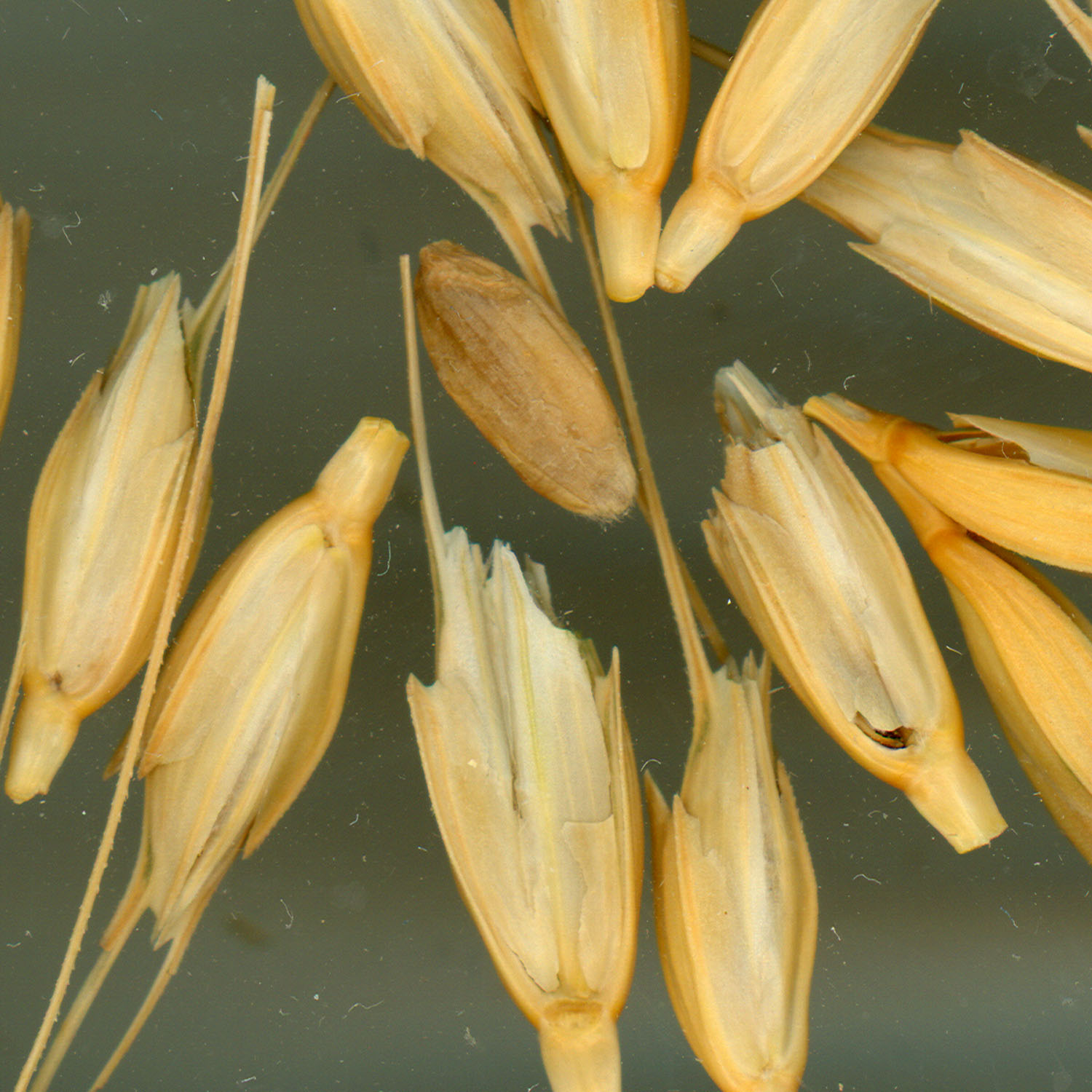
I'd like to suggest it refers specifically to the seeds in the spikelet of the wheat, a "fruit" of the wheat stalk. Looks like this:


The wheat seeds themselves look something like this:

It could be that wheat seed eating was common, and so no explanation was necessary for why wheat products could represent other fruits and nuts.

A book called Parperet HaTorah (not to be confused with Parperet LaTorah) found on Hebrewbooks points out that Rashi's answer is difficult. How can Rashi claim that Rabbi Yehudah is just being consistent in both Rosh HaShanah and Sanhedrin (and Berachot but not quoted here) when in Rosh HaShanah, he is quoting Rabbi Akiva? That would require placing Rabbi Yehudah's opinion of the definition of wheat onto Rabbi Akiva, something we ostensibly have no evidence for.

He finds a Tosafot Shabbat 66a that answers a question by saying that Rabbi Akiva holds the same thing that Rabbi Yehudah does about wheat as fruit:
ונראה בזה דגם ר“ע לשיטתו אזיל דהגמ‘ בשבת דף סו. מביאה משנה בכלים פי“ז מי“ז דתנן כוורת של קש ושפופרת של קנים רבי עקיבא מטמא ור‘ יוחנן בן נורי מטהר והקשו התוס‘ איך מטמא ר“ע הרי לא חזי לישיבה ולא מטמא מדרס, ולענין טמא מת הא לא כתיב בפרשה אלא כלי עץ ועור ובגד ושק ותירצו דקש נמי חשיב של עץ כדאמר פרי שאכל ממנו אדם הראשון חטה היה יעויי“ש בדבריהם, ומבואר שגם ר“ע ס“ל שעץ שאכל ממנו אדה“ר חטה היה, וא“כ גם ר“ע לשיטתו.
 It seems that Rabbi Akiva also hold like that opinion, as the Talmud Shabbat 66a brings a Mishnah from Kelim 17:17 that it was taught, "A straw mat or a tube of reeds, Rabbi Akiva declares capable of impurity, and Rabbi Yochanan ben Nuri declares incapable." Tosafot ask, how can Rabbi Akiva declare [straw] impure, it is not fit for sitting upon, an doesn't make unclean as a midrash, and for the impurity of the dead, the Torah only writes about wood, leather, cloth, baggage! They answer that straw is also considered wood, as it says, the fruit that Adam HaRishon ate from was the wheat, see their words there. It follows, then, that Rabbi Akiva also holds that the tree Adam HaRishon ate was wheat, so then Rabbi Akiva is going "leshitaso" [here as well].
There is another source that indicates a connection between the sin of Adam and Eve, and Shavuot. For example, Megillah 31b states:
תניא, רבי שמעון בן אלעזר אומר: עזרא תיקן להן לישראל שיהו קורין קללות שבתורת כהנים קודם עצרת, ושבמשנה תורה קודם ראש השנה. מאי טעמא? אמר אביי ואיתימא ריש לקיש: כדי שתכלה השנה וקללותיה. בשלמא שבמשנה תורה איכא כדי שתכלה שנה וקללותיה, אלא שבתורת כהנים, אטו עצרת ראש השנה היא? - אין, עצרת נמי ראש השנה היא, דתנן: ובעצרת על פירות האילן.
It has been taught: R`Simeon B`Eleazar says: Ezra made a regulation for Israel that they should read the curses in Leviticus before Shavuot and those in Deuteronomy before New Year. What is the reason? Abaye (or you may also say Resh Lakish) said: So that the year may end along with its curses. I grant you that in regard to the curses in Deuteronomy you can say, 'so that the year should end along with its curses'. But as regards those in Leviticus - is Shavuot a New Year? - Yes; Shavuot is also a New Year, as we have learnt: 'On Shavuot is the new year for [fruit of] the tree'.

Again we see that the sin with regard to the creation of the world, is connected to Shavuot's new year of the fruit of the tree.

The concept that Shavuot is somehow connected to Adam HaRishon and the sin of the tree is fascinating. That Shavuot represents the giving of the Torah is one thing, and that Adam's sin represents the giving of knowledge of good and evil is another. Does Torah-learning rectify this knowledge? What is this knowledge, after all?

This rabbi, Rabbi Lebhar, suggests that the process of counting the omer is a procession of man becoming civilized. He starts with the barley offering of the second day of Pesach, animal food, and ends 50 days later with wheat, which represents the pinnacle of human work - taking wheat, grinding it, cooking it. Before the sin, we could have just had the food. Now we have to work at it. We want to show that we are working on ourselves through Torah to become the best we can be as a human species. Nice derasha. Maybe.

Rav Tzadok on Bechukotai says similarly, but a bit differently, that we rue the fact that no longer can we devote all of our time to Torah and worship, but now have to work for our bread. We want to get back to a time when we didn't have to work:
  עזרא תיקן להם לישראל שיהיו קורין קללות שבתורת כהנים קודם עצרת וכו' כדי שתכלה שנה וקללותיה וכו' אלא שבתורת כהנים אטו בעצרת ראש השנה היא אין עצרת נמי ראש השנה היא דתנן בעצרת על פירות האילן (מגילה ל"א ב), וצריך להבין הא עיקר מאכל האדם הוא הלחם כמו שנאמר (דברים ח', ג') כי לא על הלחם לבדו יחיה האדם ובפסח העולם נידון על התבואה (ראש השנה ט"ז א) והיה לו לתקן שיקראו קודם פסח מהאי טעמא. ואם משום דלפי סדר הפרשיות מיקלע בחוקותי קודם עצרת ולא קודם פסח הא מלשון עזרא תיקן לא משמע שהוא מפני סדר הפרשיות, ובאמת לבני מערבא דמסקי אורייתא לתלת שנין כמו שאמרו במגילה (כ"ט ב) לא מיקלע בחוקותי קודם עצרת היה לו לעזרא לתקן שיקראו התוכחה קודם פסח. גם לפי מה שאמרו בגמרא (ראש השנה ז' ב) ט"ז בניסן ראש השנה לעומר ו' בסיון ראש השנה לשתי הלחם. והנה שתי הלחם הוא ראש השנה להתיר החדש במקדש אבל כבר הותר לאכילת הדיוט מט"ז בניסן מזמן הקרבת העומר ובמקדש לא שייך תכלה שנה וקללותיה. ויתכן יותר לתקן שיקראו קודם פסח שאז ראש השנה להתיר אכילת הדיוט מחדש, גם מה שתיקן עזרא שיקראו שבתורת כהנים קודם עצרת ושבמשנה תורה קודם ראש השנה ולא להיפוך בודאי יש שייכות לכל פרשה לזמנה.
  אך הענין שקודם הקלקול מאדם הראשון ניתן רק פרי העץ למאכל אדם וכמו שנאמר (בראשית ב', ח') ויטע גן בעדן ונטיעה היא באילנות אך אחר הקלקול ואכלת את עשב השדה רק כיון ששמע אדם הראשון הזיעו פניו ואמר מה אני נקשר לאבוס כבהמה אמר לו הקב"ה בזעת אפך תאכל לחם (בראשית רבה כ', י') והיינו שיהיה לו טורח לעשות מחטה לחם. וכמו שאמרו (ברכות נ"ח א) כמה יגיעות יגע אדם הראשון עד שמצא פת לאכול חרש וזרע וכו' אבל קודם הקלקול אף חטה היה מין אילן והיה גדל עליו גלוסקאות כמו שיהיה לעתיד (שבת ל' ב) ועתידה חטה שתתמר כדקל (כתובות קי"א ב) וכמו שמצינו שיש אילן שקמה המתקיים שש מאות שנה כמו שאמרו במדרש (תהלים צ') על מה שנאמר (ישעיה ס"ה, כ"ב) כימי העץ ימי עמי (ועיין בראשית רבה (י"ב, ו') אך שם מיירי לענין קומה כמו שפירש המתנות כהונה בשם פירוש רש"י) והאילנות שנטע הקב"ה בעצמו בגן עדן היה מתקיים לעולם ולא היה צריך שום נטיעה ועבודה. ואדם הראשון ניתן בגן עדן לעבדה ולשמרה לעבדה בפקודין דעשה ולשמרה בפקודין דלא תעשה (זוהר ח"א כ"ז. ותיקוני זוהר תיקון כ"א) ורק אחר הקלקול נאמר לו בזעת אפך תאכל לחם שיהיה נצרך לעבודה וטורח וכמה יגיעות יגע וכו', ובעצרת שהוא זמן מתן תורה דכתיב (תהלים פ"ב, ו') אני אמרתי אלהים אתם שיהיה התיקון כמו קודם החטא שלא יהיה מיתה (עבודה זרה ה' א) וכתיב (שמות י"ט, ו') ואתם תהיו לי ממלכת כהנים וגו' שאז לא היו ישראל רק פנוים לתורה ועבודה כמו קודם הקלקול, והיה מתבטל אז כל היצר הרע וקלקול הנחש וממילא מאכל אדם היה רק פירות האילן כמו שהיה קודם קלקול אדם הראשון, ורק אחר החטא חיבלתם מעשיכם אכן כאדם תמותון מכל מקום כשבא עצרת הוא הזמן בכל שנה לתקן הקלקול הראשון מאדם הראשון וכמו שהיה במתן תורה וזהו בעצרת על פירות האילן, וזה שאמרו בגמרא (ראש השנה ט"ז א) הביאו לפני שתי הלחם בעצרת כדי שיתברכו לכם פירות האילן ופירש רש"י דר' יהודה לטעמיה דאמר בסנהדרין (ע' ב) עץ שאכל אדם הראשון חטה היתה ולפי האמור מובן שבעצרת הזמן שיתברכו פירות האילן שיתוקן קלקול אדם הראשון ויהיה מאכל אדם פירות האילן וכמו שהיה קודם הקלקול: 

Perhaps its as simple as supposing that Torah is the elixir to the evil inclination that is in man because of the sin, as Kiddushin 30b states:
בראתי יצר הרע בראתי תורה תבלין כנגדו
I created the evil inclination, and I created Torah as the elixir against it
And indeed, in Kiddushin 21b states that:
לא דברה תורה אלא כנגד יצר הרע
The Torah only speaks in opposition to the evil inclination.
Indeed, Yerushalmi Rosh Hashana 4:8 records that Torah took away the sins of the people, as Rav Kitov points out:

ר' משרשיא בשם ר' אידי בכל הקרבנות כתיב חטא ובעצרת אין כתיב חטא אמר להן הקב"ה מכיון שקיבלתם עליכם עול תורה מעלה אני עליכם כאילו לא חטאתם מימיכם

But there may be another way. Maimonides, in Guide for the Perplexed 1:2, understands the story of the tree in a very interesting way:

Years ago a learned man propounded as a challenge to me a curious objection... This is what the objector said: It is manifest from the clear sense of the biblical text that the primary purpose with regard to man was that he should be, as the other animals are, devoid of intellect, of thought, and of the capacity to distinguish between good and evil. However, when he disobeyed, his disobedience procured him as its necessary consequence the great perfection peculiar to man... Now it is a thing to be wondered at that man’s punishment for his disobedience should consist in his being granted a perfection he did not possess before, namely, the intellect... 
[The answer:] For the intellect that God made overflow unto man and that is the latter’s ultimate perfection, was that which Adam had been provided with before he disobeyed. It was because of this that it was said of him that he was created in the image of God and in His likeness. It was likewise on account of it that he was addressed by God and given commandments, as it says: "And the Lord God commanded, and so on" (Genesis 2:16). For commandments are not given to beasts and beings devoid of intellect. Through the intellect one distinguishes between truth and falsehood, and that was found in Adam in its perfection and integrity. Good and bad, on the other hand, belong to the things generally accepted as known, not to those cognized by the intellect. For one does not say: it is good that heaven is spherical, and it is bad that the earth is flat; rather one says true and false with regard to these assertions... However, when he disobeyed and inclined toward his desires of the imagination and the pleasures of his corporeal senses, inasmuch as it is said: "That the tree was good for food and that it was a delight to the eyes" (Bereishit 3:6), he was punished by being deprived of that intellectual apprehension. He therefore disobeyed the commandment that was imposed upon him on account of his intellect and, becoming endowed with the faculty of apprehending generally accepted things, he became absorbed in judging things to be bad or good.

Truth and falsehood is innate, objective. Facts. Good and bad are externally contextual, subjective.

Good and bad, Maimonides says, is based on society. It is bad to be naked. It is good to be clothed. Nothing objectively wrong with nakedness, nothing objectively right with clothes. This was Adam and Eve's realization, and that's why their reaction is to be embarrassed and find clothes. They have now muddled their intellectual comprehension of facts, with emotional and societal pulls - conventions.

Perhaps the Torah represents an idealized knowledge of the world, that is unmuddled by the human experience. We want a day that we can return to this. We bring the two loaves, the wheat of good and bad, in hope of rectifying this mistaken attitude. We celebrate the Torah's giving, and learn much on that day(s) to rectify the muddling of truth.

I asked Rabbi Pesach Wolicki, this was his answer, in short:
Here's a short version: the different opinions re: what the fruit of the sin was are different opinions re: the fundamental cause of sin. Wheat represents human intellect and creativity. This is evident from a number of Gemaras (e.g. a child can only say Abba and Ima when he has tasted grain) Human intellect can and does cause great human problems - it is also the most exalted human characteristic - this is Torah. The shtei halechem represent the 2 luchot as well as Humanity as opposed to animals (maachal adam vs. maachal beheimah) Thus, the shtei halechem are the tikun of the cheit if we see the cheit as being a sin based in human thinking.