Tuesday, January 10, 2017

Gersonides Discrepancies

Aryeh Sklar

Understanding the Deviations Between Gersonides’ Wars of the Lord and His Biblical Commentaries

A perusal of Gersonides’ magnum opus, The Wars of the Lord (also called in Hebrew Milhamot Adonai), and his biblical commentaries, yields a surprising conclusion. For all of Gersonides’ talk of clarity and true positions, there are several instances where his two major works differ from each other, creating contradictions. In noting this, different scholars have adopted three main positions, which we shall call the three Ps, or P3 - political/religious, practical, or pedagogical. A fourth possibility will be explored in this paper, another P, which we shall call “parallelism.”
The first such approach is to declare the differences generally irreconcilable, and these were intended, perhaps for political reasons. Julius Guttmann writes in his Philosophy of Judaism that these discrepancies can be explained with a proverbial wave of the hand.
“There [in his commentaries to the Bible], we come across deviations from positions outlined in the Milhamot, but we must not conclude that Gersonides’ true doctrine is expounded in the commentaries; in these, he conscious or unconsciously adapted himself more to the traditional religious viewpoint, but it cannot be doubted that the proper source of his major views is in the Milhamot.”
As noted by Robert Eisen in Gersonides on Providence, Covenant, and the Chosen People, “Guttmann... offers no evidence for his far-reaching claim. Moreover, he is the only scholar, to my knowledge, who holds this view.” Further, we note, Guttmann does not explain what motivation there would be for Gersonides to adapt himself for a more religious viewpoint, and this lends an air of speculation to his opinion.
We could offer some suggestions to what he may mean. One that readily comes to mind is putting Gersonides in Maimonides camp when it comes to contradictions. As in, if we were to align this with one of the categories in Maimonides regarding why a writer might contradict himself, it would be with Maimonides’ seventh cause, and indeed what Maimonides claims he would use in his work, in his introduction to the Guide for the Perplexed. There, he states that a write might conceal some ideas that he is required to, applying to this the religious dictum of not relating metaphysical truths to the uninitiated. So too, Guttmann may mean that Gersonides did not want to reveal truths to the uninitiated religious folk who would misunderstand him. Another possibility is that, as others claim about Maimonides, it was a political problem; his theological solutions are actually heretical theories that place him outside the scope of traditional religious medieval society. Any attempt to relate Gersonides to Maimonides when it comes to these issues is very difficult to accept, as we will proceed to show.
On the other hand, Jacob Staub, in The Creation of the World According To Gersonides, argues that the discrepancies can be attributed to differences in writings forms between a philosophy book and a commentary. The reason why Gersonides allows for seeming contradictions, posits Staub, is because the needs of exegesis cannot accomplish what Gersonides can do in essay form in The Wars. He writes, “[Gersonides’ biblical commentary] is not systematic and has the structural disadvantage of moving from passage to passage of the Biblical text…” Instead, he assumes that these inconsistencies can be resolved through close readings. “Working with the assumption that he was a competent and consistent thinker, [we will] attempt to resolve apparent inconsistencies and errors by referring them to other of his statements and by seeking to construct the common assumptions which underlie all of those statements.” In this, we might place Staub’s Gersonides within the fourth cause of contradiction: a practical necessity of describing the same thing in different ways
This assumption of Gersonides’ unitary integrity can also be found in the works of Seymour Feldman on Gersonides, with a major difference. He writes, in his introduction to his translation of The Wars of the Lord, that Gersonides meant his biblical commentaries for a more general audience, and so philosophical ideas would be presented in a less technical fashion. Instead of aligning the biblical commentaries with “traditional religious viewpoints” and seeing this as a conflict, like Guttmann does, or Staub’s promise of absolute reconciliation between the two works, Feldman describes them as “a popular introduction to or substitute for The Wars,” and “companion pieces to several of the books of The Wars.”  In Feldman’s Gersonides: Judaism Within the Limits of Reason, he states further, “The reader of Gersonides’ biblical commentaries can acquire from them an accurate, if simplified, version of his general philosophical position…” And to be even more outright, Feldman declares, “There is here no dualism between the philosophical author of the Was and the exegete of the biblical commentaries… The mutual cross-referencing… reveals...a unified system.” Thus, we might say that the contradictions or discrepancies found between the books would be described as fitting in with Maimonides’ fifth cause of contradiction: pedagogical necessity to allow the student to first understand the matter in a looser sense the technical truth, before the student can tackle the technical truths.
To summarize these three approaches, we can put it in the following fashion: the discrepancies found in Gersonides’ works are either caused by reasons political/religious (as per Guttmann), practical (as per Staub), or pedagogical (as per Feldman). However, as stated above, there is a fourth P we should like to offer in this essay. We will call it “parallelism,” and it explores the possibility that Gersonides believed in two parallel tracks for his readers when faced with the religious drive and the philosophical search - the importance of belief in conclusions, and the knowledge of the demonstration toward that truth. We are suggesting that Gersonides accepted both as important tracks of religious and philosophical life, and that a fully religious and philosophical student would need to encompass both tracks to be successful.
Thus, in the course of this essay, we will show that the most compelling approach is P4. It is our contention that Gersonides believed in an inherent contradiction and tension between religious life which requires belief in religious conclusions, and philosophical life, which requires knowledge of how one arrives at those conclusions. By maintaining this tension in his writings, he can allow different people who balance the two aspects at different stages to perfect themselves by allowing for the contradictions to remain. In this way, synthesis between the approaches above can be maintained, wherein the contradictions are indeed irreconcilable, but being purposeful to Gersonides, who wanted his various readers to arrive at the same truths in different ways, and allowed for the tension inherent in such a project. Since we are limited to the scope of this paper, we will explore the issue of esotericism. Since this encompasses both The Wars and his Commentary, and especially since it impacts the topic under discussion, it is ripe for exploration with regard to this paper.
It seems from Gersonides’ introduction to The Wars as if the book was written for an exclusively philosophically sophisticated audience. He certainly believed that to be able to fully understand his book, his reader must be well-versed in scientific knowledge. He writes, “Now it is without a doubt essential that the reader of this book be familiar with the mathematical sciences, the natural sciences, and metaphysics.” Already we sense an elitist attitude, a la Maimonides. Further, he explicitly tells the reader that he cares not for those who will object based on inherited opinions from others, but aren’t interested in philosophical argumentation. Regarding them, he writes, “[W]e are not concerned with these people; for it is sufficient for them to believe, not to know. We are concerned with those who are deeply perplexed by these questions…”
What does Gersonides mean by the phrase, “it is sufficient for them to believe, not to know?” At first glance, it is a reference to the need for esotericism when writing and teaching certain topics to those unable to handle the explanations, since those students lack the intellectual background to do so. Towards this can be marshalled an interesting passage from Gersonides, in his introduction to his commentary to Song of Songs:
It [i.e., the Torah] hinted at this end and commanded it-it being cleaving to God-and referred to many of the wonderful speculative matters in some of the narratives and commandments, and in describing the sanctuary and its implements, as if guiding the elite to [the realization that] the rest of the commandments are for this end. However, it said for the multitudes, concerning many of the commandments, that they who observe them will thereby achieve length of days and many [other] fanciful felicities, and the opposite concerning those who do not observe them, even though the Torah commandments are not for this purpose. This is so since the multitudes cannot picture the purpose of the Torah commandments, since a man will not desire to perform some action if he cannot picture some advantage for himself; thus, the Torah guided [the multitudes] to fulfill these commandments first for this purpose, and through performing this worship first not for its own sake they will be guided to doing it afterwards for its own sake.
This would indeed indicate Gersonides belief in certain “necessary truths” meant for the ignorant public, and the Torah’s “true opinion” hidden for the advanced intellectual. Gersonides also goes on to describe other books of the Bible as meant for different audiences, some for the masses, some exclusively for the elite (such as Song of Songs), and some for both on different levels. Again, it would seem that Gersonides supports a kind of esotericism, and sees the Torah as engaging in such tactics. Further, in his commentary to Proverbs 11:13, he calls the person who “gives away” divine secrets “repugnant” because he “causes great harm to his people.” If we only saw these quotes, we should rightly conclude that Gersonides supports an elitist esotericism because of how it may damage those unable to handle the truth. Guttmann, then, would have something to hang his hat on.
But here is the more significant point. Gersonides, by explicitly distinguishing and describing the two messages meant for both audience in his Torah commentary, undoes the esoteric nature of such tactics. If indeed the different approaches are spelled out, the ignorant person and the elite individual are put on the same playing field; the belief of the masses and the knowledge of the intellectual are allowed to occupy the same space. Eisen points out in his discussion of Gersonides’ esotericism that one would expect Gersonides in his exegetical writings to make frequent reference to this distinction between the divergent messages in certain books meant for both the elite and the masses. In point of fact, he scarcely does so. However, one of his rare cases is significant to us. As Eisen summarizes Gersonides’ interpretation of Deuteronomy 6:4’s, “Hear, O Israel! The Lord is our God, the Lord is one”:
Gersonides sees in this imperative a double meaning. To the elite, Moses is commanding that one comprehend God's existence and oneness by means of philosophical verification. For the masses, who cannot achieve this kind of philosophical understanding, the commandment is an imperative to believe in those same concepts but without rational justification.
Thus, we again see the distinction between the requirement to believe, meant for the masses on one hand, and the requirement to know, meant for the elite on the other. But again, each type of reader reading that very interpretation would be made aware of the very message meant for the other. If Gersonides wrote his Commentary for both, then by putting them together in the same comment, he has put them on a spectrum. The masses are simply people not yet reaching the knowledge of the elite, but very capable of believing in the conclusions. Put a different way, the student seeking to become elite must first occupy the place of the masses, since at that point he can only believe in truths without being able to demonstrate them. These lives of tension are what contradictions in Gersonides represent.
To this point, we return back to The Wars, where we find statements not at all supporting an esotericism. There, Gersonides provides an altogether different approach as to why he wrote a book of Jewish philosophy. To him, “[I]t is not proper for someone to withhold what he has learned in philosophy from someone else. This would be utterly disgraceful. Indeed, just as this entire universe emanated from God for no particular advantage to Him, so too is it proper for someone who has achieved some perfection to try to impart it to someone else. In this way he is imitating God as best he can.” Thus, to teach what he has learned is a function of imitatio dei. It would seem that this would not allow him, either in The Wars or the Commentary, to deviate from imparting perfection to others. Indeed, he notes his hesitancy to write a book at all, since there are those “who are fools but wise in their own eyes, especially on these profound topics.” Still, he is determined to write, since it his “strong desire to remove the obstacles that block the man of inquiry from attaining the truth…” What we see here is that Gersonides simply does not believe in hiding knowledge. Gersonides is emphasizing here the equality of all students seeking truth, and the requirement of the religious teacher desiring imitatio dei to fulfill that search.
Additionally, Gersonides does not believe there is an issue with interpreting the Torah in a manner contrary to its literal meaning, even though this may raise the ire of some religious readers. He writes, “It is… evident that if reason causes us to affirm doctrines that are incompatible with the literal sense of Scripture, we are not prohibited by the Torah to pronounce the truth on these matters, for reason is not incompatible with the true understanding of the Torah.”  It is in this context that we start to see that no matter where he would write, he would not avoid the philosophical standpoint even if it conflicted with religious doctrine. On the other hand, he seems to contradict this statement with a chapter at the end of the first book of The Wars, entitled, “Some Hints To Our Readers So That They Do Not Abandon What Religion Affirms Because Of What Philosophy Seems To Teach.” He writes there, “If there appears to be a problem concerning which our view differs from the accepted view of religion, philosophy should be abandoned and religion followed.” In the first quote, not only is imparting philosophical knowledge an act of imitatio dei, but, to Gersonides, the very content of that knowledge cannot possibly conflict with the true intended interpretation of the Torah. Yet in the second, there is a tension and one is advocated to follow belief, not philosophy. But in fact, if we view Gersonides as keeping in mind two type of people and two balances, both are true, depending on the person. In such declarations, belief and knowledge converge. There are times that emphasis on belief is appropriate, and times that emphasis on knowledge is appropriate.
It seems to this writer that Gersonides viewed Maimonides as living in this tension, but in certain instances did succeed in rising to the correct philosophical conclusion. The way he describes Maimonides’ errors are exactly on this point. For example, he states, “It seems to us that Maimonides’ position on this question of divine cognition is not implied by any philosophical principles; indeed, reason denies us this view… It seems that theological considerations have forced him to this view.” To Gersonides, Maimonides is not wrong for having considered theological issues. But the fact that reason does not require the believer to believe false doctrines, and Maimonides’ approach emphasizes the theological over the philosophical, allows Gersonides to argue and “right the balance,” so to speak, to the benefit of the religious philosopher. Again, Gersonides writes of Maimonides, “It is evident that the dispute with them [the philosophers] should be philosophical and not from the Torah only.” These criticisms show that Gersonides viewed Maimonides as placing emphasis on Torah conclusions to the detriment of the philosophical push.
To summarize what we have seen at this point, Gersonides seems to support an esotericism that delineates what the elite individual cannot and should not teach to the ignorant masses, yet opens The Wars to all who wish to read it, and also explains passages in his Commentary to the Torah according to both the masses and the elite. In other words, the very contradictions in positions present in Gersonides’ works reaches even to the depths of what he will share to the masses and to the elite! The approaches of Guttmann, Staub, and Feldman, are only small pieces of the bigger picture of Gersonides intentions between the two books. For purposes practical, pedagogical, and religious, Gersonides wrote a different book in the Commentary as he did in The Wars. That said, the very audience is not different. Both books are meant for both the masses and the elite, who are really on the same spectrum, in the same way that Gersonides views the Torah as being written for both audiences.
Towards this, Eisen has relevant explanation of this phenomenon in Gersonides. He suggests that Gersonides believed that the ignorant individual, given the right education, could reach philosophical heights, and Gersonides did not want to deny him this. He finds this most important in Gersonides' commentary on Numbers, in which he explains why the Tetragrammaton was pronounced only within the confines of the Temple. Eisen writes:
Normally, the masses should not have been exposed to the divine name because they might have misconstrued its philosophical meaning. However, the presence of philosophically trained priests safeguarded the uninitiated from any harm. Here we see quite clearly Gersonides' conviction that the masses can be taught philosophical truths, so long as there is proper philosophical guidance available.

This approach does not fully help us resolve the contradictions between both works. Either the Commentary should be a simpler version of The Wars, like Feldman proposes, or each book should contain the same education-building curriculum, like Eisen suggests. We would add to this that it may be true that might be an educational philosophy here of the willingness to teach the masses on their level to help them reach the elite status. However, it would seem that Gersonides is content with most of the masses staying as the masses. We’ve seen that when someone of the masses views the Torah as contradicting philosophic reason, he should support the Torah interpretation. And Gersonides does not combat such an approach to religious life. Stated differently, Gersonides wants the reader to stay in his level. He does not combat Maimonides because of what he views as Maimonides’ loyalty to theological positions, but certainly sees his positions as Torah-based, and not philosophically based. Instead, Gersonides recognizes that Maimonides, and indeed every reader, struggled, as every religious person does, with philosophy, and the need to speak to both sides exists throughout his writings.

Polish Hasidut and Alcohol

Aryeh Sklar


Polish Hasidut and Alcohol Consumption


Arnold B. Ehrlich, born in Poland in 1848 and died in New York in 1919, was an extremely interesting and multifaceted individual. A scholar and polyglot, he wrote a commentary to the Bible incorporating his Bible critic views called “Mikra ke-Peshuto.” Having lived in Poland until only 17, he then went to Germany for several years, finally settling in New Rochelle, New York around 1880. His aforementioned commentary, written in Hebrew, was published in Germany and then in New York, and includes comparisons to other languages and scripts. Among his sometimes dry comments on grammar are indeed humorous ones as well.
One of these occurs in his commentary to Deuteronomy 31:16. The verse states that God says to Moses, “You are going to rest with your ancestors, and will rise the people...” Thanks to the lack of punctuation in the Hebrew Bible, the Talmudic sage Rabban Gamliel declared that this was proof of the revival of the dead in the end of times, since the sentence could be read, “You are going to rest with your ancestors, and will rise…” Ehrlich states,
This is not because ‘will rise’ is capable of applying to the preceding clause, but rather that when the Sadducees questioned Rabban Gamliel where there is proof for the resurrection of the dead in the Torah, he pushed them off by reading the verse as such, where ‘will rise’ can be seen as applying to the previous clause, wherein God was hinting to Moses that he will rest with his ancestors and then rise (TB Sanhedrin 90b). And then, because of Rabban Gamliel’s apologetic response, his students lost the appropriate way to treat the clauses of the verse (TB Yoma 52).
Ehrlich goes on to describe his times as related to those times (and this is why we are mentioning it here):
I will mention here something that happened regarding Polish Hasidim, sheep of our holy people, who love the times of Purim more than any other holiday, since they are commanded to be drunk, and out of their love for it they uphold those days for three days. And they give a reason for their adding [to the one day of Purim], saying, “We act this way because the it is a question in the Talmud regarding the 16th day and the 17th day (Megillah 2b).” And not only that, but when they drink and get drunk, they turn that question of the Talmud into song, and they sing, "And I'll say the 16th and the 17th!?" So too, were the students of Rabban Gamliel, who drank from the cup of his consolation, they drank and got drunk, and turned his words into a song, “You are going to rest with your ancestors, and will rise!”
Beside for the humorous and denigrating view of Ehrlich toward the contemporary Hasidic groups in his homeland of Poland, his report that Hasidim were particularly known for their love of drink, and therefore their love of the merry holiday of Purim, deserves some research. Regarding this particular story, we should suspect it an exaggeration. Ehrlich’s connection to Hasidic Jewry, especially in Poland, was tenuous at best, and hostile at worst. True, he was originally from there, and he may have heard stories, or seen certain people who celebrated Purim this way, this story still cannot be taken as fact. Indeed, his main point was to connect it in a somewhat homiletical manner to the pain of the exile in Talmudic times, which does not necessarily make for factual reporting. In fact, after much research, I have found this story repeated in only one other place, in another context of great derision toward this act, and also a generation later, in Rabbi Zvi Yehudah Kook’s Sihot al Erez Yisrael, in an essay entitled “Hakol Ma’alin le-Erez Yisrael.” (The reason this is so interesting is that it is far more likely that Rabbi Zvi Yehudah read Ehrlich, than the supposition that they share the same source or rumors. See the following picture of the paragraph in question:)

There are, then, two questions to ask when reading this story. Firstly, is the historical reality true, i.e. that Hasidim in 19th century Poland would have been known for their love of strong drink, such that a story like this can be evidence of a common occurrence? And secondly, given that Hasidim are devout followers of their Hasidic leaders, do the rabbis of Hasidic sects in Poland provide guidance or justification in any way toward the consumption of alcohol? If these leaders glorify the consumption of alcohol, we would expect that the followers would respond in kind. And so, the story would be assumed to be correct enough, given the historical and ideological circumstances. However, if the ideological stance of the leaders is found to be much more of a forbidding type when it comes to the consumption of alcohol and drunkenness, then the questions begin to arise whether this story can be seen as within the realm of possibility. If the Hasidic followers were disobeying their leaders and drinking, then we must then question why this should be so. In this paper, we will endeavor to explore these questions in depth.
It is clear that associations of Hasidut and alcohol are not historically unfounded. Glenn Dynner, a scholar who has spent much of his academic energy on the question of Hasidic history and alcohol, has written several articles and books about this topic. In particular, his article, “Jewish Drinking Practices and the Sobriety Stereotype in Eastern Europe,” is a goldmine of information, particularly relevant to our examination of Poland in the Hasidic community. Interestingly, the article notes, the existence of Jewish-owned taverns was commonplace in Poland in the 19th century. However, many outsiders viewed the Jews as tee-totalers, completely sober even as their common profession was often to serve strong drink. Polish noble Antoni Ostrowski described the Jews as, “always sober, and this virtue should be conceded: drunks are rare among Jews.” Father Karol Mikoszewski writes, “a Jewish drunk is hard to find.’’ Apparently, this was generally meant as an anti-semitic view of the Jews. They were viewed as such so as to portray them as sober exploiters of the drunk, better able to part the gentile peasant from his hard-earned cash, while the Jew would not touch the stuff. A common peasant proverb was, “the peasant drinks at the inn and the Jew does him in.” Indeed, partly because of this, there was a kind of prohibition on Jewish alcohol sale.
This reality, posits Dynner, was the cause for Jews to portray the gentile in contrast to them. In Dynner’s words, the Jews, “countered accusations of sinister sobriety with a demeaning stereotype of drunken gentile profligacy.” Indeed, there was a popular Jewish song called ‘‘Shiker iz der goy’’ (The gentile [goy] is drunk), that placed this contrast in its fullest. Dynner translates it this way:
The goy goes to the tavern/ he drinks a glass of wine/ oy, the goy is drunk, drunk is he/ drink he must, because a goy is he,’’ the first verse proclaims. The next verse presents his mirror opposite: ‘‘The Jew goes to the studyhouse/ he looks at a book/ oy, the Jew is sober, sober is he/ learn he must, because a Jew is he.
However, the outsider’s perspective of the Jews was not always the same as the internal awareness from others. Tzevi Hirsch Kaidanover’s Kav ha-Yashar rails against what he viewed as a problem of alcohol in Jewish society. ‘‘I have noticed that many people in this region are so enslaved to their appetites that immediately upon awakening, hours before dawn, they believe they will die if they do not drink hard liquor.’’ He also called praying while drunk, ‘‘a terrible sin . . . which many luminaries have committed.’’ Dynner notes that the rarity of such protests in 19th century Jewish Polish writings, especially contrasted with the much more common Christian sermon mentionings of the ills of alcohol, means that alcohol was hardly a Jewish societal problem.
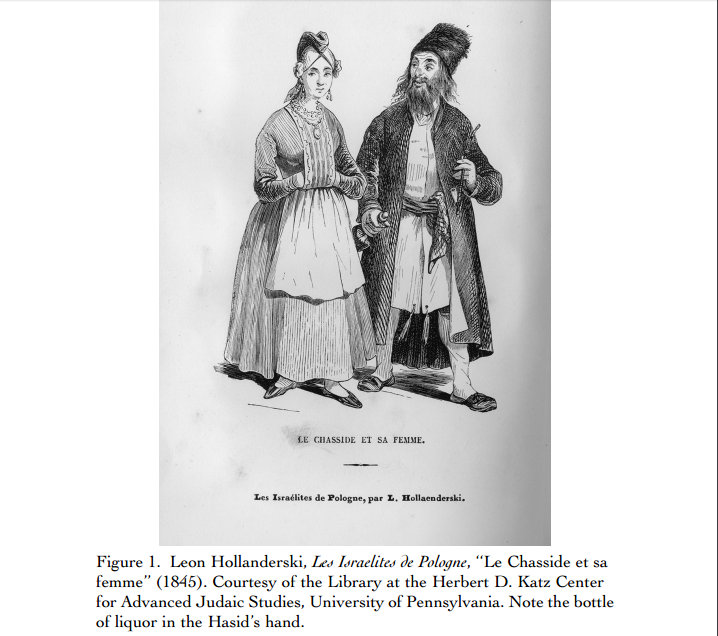
However, he waffles on this point. He states that the influence of Hasidic glorification of drinking definitely contributed to drunkenness being more common than not. In fact, some portrayed Hasidim as always being drunk. The Maskilim, enlightened Jews, saw the Hasidim as drunkards as well. The maskil Yehezkel Kotik accused the Hasidim of his town of having ‘‘spent days and nights on end in the shtibl, dancing, singing, eating, and drinking, while their wives and children all but starved to death.” Additionally, though we have seen Ehrlich’s colorful description above, but still others had more visual ways of displaying their view of Hasidic drinking in 19th century Poland. The below picture was meant to be a Jewish stereotype of a Hasid in that time and place. Dynner wants us to notice the bottle in the Hasid’s bottle, but also notice his ruddy nose:
hasid drinking.jpg
Not only did enlightened Jews denigrate the Hasidic Jew as mired in drink, but so was this an accusation from the opponents of Hasidut, the Mitnagdim, directed toward the Hasidim. The common diatribe was regarding the Hasidim’s customary “imbibing of wine and dancing, and in their dancing like rams, each man grabbing his neighbor’s neck, and chanting and singing, ‘The Rabbi ordered us to be joyful.’” Satire and parodies from the mitnagdim making fun of Hasidim sometimes made up, in Dynner’s words, “some of crudest, unrestrained satires in the history of Jewish literature.”
To Dynner, the explanation of the difference between the outsider’s view and the insider’s view comes down to how much access to knowledge of rituals in which Hasidim participated. Since, Dynner posits, most Hasidic drinking took place in ritualized and spiritual contexts, the outsider would not necessarily have seen these situations. However, the insider would know of these contexts and therefore see the Hasid as using his religion to be drunk all the time. In Dynner’s words, “The Jewish sobriety stereotype seems to have been sustainable throughout the rise of Hasidism because Hasidim confined the heaviest drinking to sacred times and spaces like the prayer house (shtibl) or the tsadik’s court.”
All of this creates a context for Ehrlich’s story. Even though outsiders saw a very sober society, and even many Jews considered themselves sober in contrast to the gentiles, those in the know, like Ehrlich, could describe a situation from the inside where the whiskey flowed freely. However, there is still an issue we must tackle. Does alcohol play a large role in Polish Hasidic writings?
Here’s where it gets interesting. Polish Hasidut is a mixed bunch when it comes to the consumption of alcohol. Given this, the ebb and flow of support and disapproval of alcohol consumption can be useful to us in gauging the changes in Polish Hasidic understanding of their culture, as well as how it might have been seen by outsiders. In the 18th century, early Hasidic leader R. Elimelekh of Lizhensk spoke out strongly against alcohol consumption. He writes in his Hanhagot Adam #18, “It is essential that one guard himself from alcoholic drinks, since this is a terrible sickness, and brings one to a great downfall.” One of R. Elimelekh’s closest disciples, R. Kalonymus Kalman Halevi Epstein, takes a slightly softer stance on alcohol. He writes in his Maor va-Shemesh, Parashat Vayeshev, s.v. va-yesaper, that,
Wine can be good for a person, but it can also be bad for a person. The books say that wine represents din, such that so long as the wine does not go from potential to reality, like the grape vine, that is good… When it transforms from potential to reality, that is din, like the books say that Eve squeezed out a cluster of grapes… and Noah, who became drunk through his wine, which is represented by din.
However, a bit later in Poland, things start to change. Hasidut in Ger begins to look more supportive of alcoholic drinking. Dynner already remarks regarding R. Simha Bunem of Pshyskha (Przysucha), that he “recalls that when spending a Sabbath evening with the tsadik Moses Hayyim Ephraim of Sudilkov (Suzylkow) in the home of the latter’s patron, R. Moses ‘ordered his attendant to prepare him a big goblet of liquor for the night.’” We can add that R. Menachem Mendel Morgensztern of Kotzk, known as the Kotzker Rebbe, in several places, considers drinking a valuable aspect of religious life. In his Emet mi-Kotzk Titzmah (158), he comments on the verse in Esther 5:10, “And the king asked in the feast of wine, What is your request?” There, he is quoted as saying that, “Israel is not only answered during their prayers, but even when they gather for a meal celebrating a mitzvah, eating with fellows, and drinking l’chaim, the Holy One, blessed be He, asks, ‘What is your request?’”
The l’chaim seems integral to Kotzk life. In the biography ha-Rebbe mi-Kotzk, there are several stories of R. Menachem Mendel’s l’chaims. For example, one story (127) reports that R. Menachem Mendel entered the study house on the night of Simhat Torah with a large bottle of strong drink, and proceeded to proclaim what the Torah taught him was “L’chaim”, to which he poured the drink into a cup, raised it up, and drank it.
Around this time, elsewhere in Poland we find a hemming back and forth, with R. Shmuel Bornsztain, the author of Shem mi-Shemuel, quoting his father R. Abraham Bornsztain (late 19th century), who seemed both lenient and restrictive when it comes to alcohol. A Talmudic passage states that, on the holiday of Purim, one is, in the Talmud’s words, “obligated to drink until he does not know between ‘Blessed be Mordechai’ and ‘Cursed be Haman.’” In much of Hasidic texts about this obligation, it is celebrated and the concept of intoxication is glorified in the context of Purim. However, in his Shem mi-Shemuel, commenting on the portion of Toldot in Genesis, he quotes his father that this obligation is absolutely not about getting drunk, but that one is obligated just to drink. That said, he writes, the obligation is the let go of inhibitions in knowledge, and this can be accomplished by alcohol. Thus, both sides of the coin are represented.
Similarly, back in Gur, we have the Sefat Emet writing against the concept of getting drunk on Purim. He writes in his commentary to Talmud Megillah (7a), s.v me-hayav, that, "It seems appropriate to explain this passage that it is not the intention to obligate one to become so drunk that he does not know, but that he is obligated to spend all day in feasting, to the point that he's not sure if he's accomplished the obligation of feasting. But even before he gets to that point, so long as he spends the day in feast, he has accomplished his obligation. So it would seem to me.” Thus, the unrestrained permission for alcohol is restricted and a person is focused less on inebriation, but in celebration.
In Poland around this time we have R. Tzvi Elimelech Spira of Dinov, author of "Bnei Yisaschar" on the times of the year, writing that Purim is an exception to the rule in Judaism that one should not drink and get drunk. Drunkenness, declares R. Spira (Purim, Maamar 4), is a “disgusting character trait (middah megunah)”, but is allowed on Purim for certain reasons of divine judgement on that day. The fact that he calls this a “disgusting character trait” certainly implies that normally, one is expected to refrain from drunkenness.
Another Hasidic leader from this stock is R. Zadok of Lublin. In his plethora of writings, he refers to the nature of alcohol often. One prime example of such a balanced view of alcohol comes from his Mahshevot Haruz, 160, where he speaks of alcohol as only worthy to lift depressed spirits of mourners. “But someone who has joy, he should not seek extra joy in this world, while God cannot be completely joyous in His world… Wine is said to give reward only to the wicked, for they trade in the joy of the world to come for extra joy in this world.” Thus, strong drink is ill-advised for the regular person.
Another Ger Hasidic leader, R. Mordechai Yosef Leiner of Izbica, speaks of similar themes of the nature of alcohol. In his commentary on the Torah, Mei ha-Shiloach, he refers to the needs of higher religious leaders of the Jewish people needing to have clear heads not only to lead the people properly, but to worship God correctly. Thus, in the beginning Parshat Shemini, he explains why, in the aftermath of Aaron’s sons dying, the priests were forbidden from drinking during the priestly service. In context, he says that drinking can make one angry and too particular against people’s mistakes. Thus, Aaron and his children as leaders were enjoined against drinking, as being sober would prevent the rigidity that comes with drinking.
In the next comment, R. Leiner hedges. He comments that in general, drinking is not good for religious worship because it “makes one’s head heavy.” This is why it is forbidden for a priest to drink “in order to get drunk, since the priest needs to constantly be in a state of awe and knowledge.” He goes on to note that the tribe of Judah is blessed by Jacob in the end of Genesis regarding the drinking of wine, since the religious king is constantly aware of God just by being a king. Since kingship belongs to the line of Judah in that blessing, wine will not affect him and cause him to be drunk, since knowledge of God is constantly on him.
Thus, to R. Leiner, there are two leaders, of spirituality and of society, and each one has a different aspect of drinking in relation to them. Not only this, but permissibility of wine is limited to those leaders who can maintain their knowledge of God. But what of regular people? It is apparent from another comment of of R. Leiner that alcohol is considered to have extremely negative effects for regular folks. In his commentary to Parshat Shelach, s.v ve-hakriv, he notes that the command to libate with wine onto the altar during the sacrifice rituals is to symbolize that even though Jews may metaphorically be lacking knowledge (by turning away from God), they can still be full of praise. Wine, he says, “represents forgetfulness and burden,” since that is its effect on a person. By relating wine to forgetfulness of God regarding the regular person, we see that the properly religious person should avoid it at all costs.
What we have found in this study of various writings of Hasidic leaders of Poland in the 18th century, is that there is a decidedly negative view in general of the place of alcohol in religious life. Instead, it is limited to certain times or to certain people, and certainly praise is not granted to its inebriating powers. So we return to our original set of questions. If the mitnagdim and the maskilim could see the inner goings on of the Hasidic life, and were accurately describing (if polemically exaggerating) the commonplace nature of alcohol consumption in Hasidic life, why were the Hasidim generally defying their leaders?

We would like to suggest that we should connect two strange facts we have seen so far. Hasidim drank a lot, that is clear. And yet, they also generally viewed themselves as sober in contrast to the disgusting drunkard gentile. This likely occurred because of the widespread Hasidic idea of the tzaddik. The tzaddik was capable of reaching great heights, which the Hasidic follower could never dream of reaching. In this paradigm, the idea of abstention from the drinking of alcohol was perhaps considered ideal, but impossible for anybody but the Hasidic tzaddik and leader. If so, the praising of the sober Jew who studies in the study house all day, as the folk song went, was meant wholeheartedly, even if it was considered a realistic goal for the average Jew in Poland. The Hasidic leaders may have described the ills of alcohol, perhaps indeed as a response to those viewing them as drunks, but the followers may not have been able to resist the temptation that alcohol held. As time went on, the leaders would shy away from a fully explicit condemnation of drinking, but certainly limited it to religious and ritual contexts.

Misanthropy and Gulliver's Travels

A rough draft (from years ago) that incorporated certain quotes from my sources (unattributed).

In August of this year, the online magazine Salon published an autobiographical story about a young wife who realized that her husband was a misanthrope, descriptively titled, “I Married A Misanthrope.” Her story is about how she realized it and why it makes her unhappy. Now, she had known throughout their short dating relationship that he was not a very social fellow, and had problems connecting with others. In fact, she loved him even more for it, because his love for her meant that she was one of the few people he could connect with. In her words, “it was flattering to be one of a very select few on someone’s list of bearable others, to make the cut and thus be needed so intensely.” But she hadn’t realized she would be an entire world to someone because he could not connect to others, and it made her feel burdened. Not only that, but his refusal to go to parties and social events made her feel that she was leaving him out and that “she was having fun without him.”
The story is altogether strange, because none of her descriptions of her husband would lead the reader to believe him a misanthrope. A comment left by a reader on the story summed it up perfectly: “This guy's not a misanthrope; he's just socially awkward. He doesn't dislike people; he merely dislikes the inconvenience attendant to social interaction.” That reader is right. Misanthropy takes a certain amount of hate for the human species, a pessimism of the abilities (or lack thereof) of humanity, a disdain for the trappings of human nature. “I Married A Misanthrope” is not about a misanthropic husband, but a socially-handicapped one. And there is a not-so-fine line distinguishing between the man who hates humanity, and the man who hates interacting with humanity.
If there is any story that indicates its author’s misanthropy clearly and distinctly, it is Gulliver’s Travels, by Jonathan Swift. Whether religion, social mores, or human nature itself, Swift attacks them all in a paradous fashion throughout his books which make up Gulliver’s Travels. This is clear even in how he breaks up his stories, or the worlds through which Gulliver travels. In the first book, Gulliver is shipwrecked in the empire of Lilliput, where he finds himself a giant among a diminutive people. The Lilliputians are small, toy-like, cute - yet vicious and mean beyond their stature. Gulliver is much like Swift in British society, a giant amongst small, bickering people. In the second book, Gulliver finds himself in a land of giants, creatures ten times as large as Europeans. Though he is worried that they will be giant monsters, the reverse proves to be the case. But even as Gulliver begins to recognize that the place is very much utopian, he refuses to recognize this view, holding as he leaves the land that Europe is superior to Brobdingnag. Between the two books, Swift is commenting that it is easy to recognize the smallness in others, but it is not so easy when we are the small ones! These are very much attacks on social and political problems inherent in the human society of Swift’s time. In the third book, to Laputa, Swift is chiefly concerned with attacking extremes of theoretical and speculative reasoning, whether in science, politics, or economics. The point is that Swift believes it a fool’s errand to attempt to speculate about things such as metaphysics, for we’ll never know for certain. This is a limitation of the human mind. In the last book, book four, Gulliver is set between a race of horses, Houyhnhnms, who live entirely by reason except for a few well-controlled and muted social affections, and their slaves, the Yahoos, whose bodies are obscene caricatures of the human body and who have no glimmer of reason, but are mere creatures of appetite and passion. In the first three books, Gulliver saw himself in relation to humans, but here he is suddenly forced into comparison not with human beings at all but animals, and two orders of animals. The obvious moral symbolism which is present throughout the fourth book is that sometimes horse could be better than humans; on the other hand people may, by forfeiting their humanity, becomes bestial. So, the four books represent at least four strong critiques of humanity.
Indeed, even the way that Gulliver arrives at each place is either a mistake or malice by someone. In the first voyage, accident, or at worst the carelessness of the lookout, accounts for the shipwreck. In the second, Gulliver is left alone in a strange land through the cowardice of his shipmates. In the third, he is captured and later abandoned by pirates. In the fourth, his crew of cutthroat mutineers seizes his ship and leaves him to starve on a nearby island. When it is malice, it is because Swift is trying to impart that when push comes to shove, people watch out for their own skin while sacrificing other. People are not fundamentally good. When it is an accident or carelessness, these are also human faults in that they had not prepared fully beforehand, which caused deaths of others. Humans like to say, “To err is human,” or “People make mistakes,” but these are just ways of making ourselves feel good for some things that happen all the time because of our recklessness.
Another aspect of Swift’s use of literary tools to malign humanity is seen in his creation of a sense of realism and verisimilitude that contrasts sharply with the fantastic nature of the tales. The style and tone of the book is one of a common travelogue, something fairly common in Swift’s time. There are all kinds of nautical terms and jargon, and sounds very factual and real. As Tuveson points out in his essay in , "In Gulliver's Travels there is a constant shuttling back and forth between real and unreal, normal and absurd...until our standards of credulity are so relaxed that we are ready to buy a pig in a poke."
Gulliver, as the protagonist, is even used literarily to show Swift’s misanthropy for the human race. As Orwell points out in his essay “Politics vs. Literature — An examination of Gulliver's travels,” Swift changes Gulliver’s personality throughout the various voyages to reflect the most contrast between humans and the people he meets. So in the first voyage, he is a typical 18th century explorer, but strong, a man with children. Spectacles as a symbol of wisdom are mentioned several times here. He is the ship’s surgeon (although that wasn’t a particularly skilled job back then). This is so as to be a contrast to the petty and small people of Lilliput. But then, in the second voyage, he changes, ever so slightly. Suddenly he is a bit silly. As Owell puts it, “... at moments when the story demands it he has a tendency to develop into an imbecile who is capable of boasting of ‘our noble Country, the Mistress of Arts and Arms, the Scourge of France’, etc., etc., and at the same time of betraying every available scandalous fact about the country which he professes to love.” This, too, is to give contrast between the imbecilic humanity, represented by Gulliver, and the wise people of Brobdingnag. In Laputa he changes again to be almost wise, moving up the social scale as an observer of the foolishness of speculation. And lastly, he becomes completely different, almost a religious recluse whose only wish is to meditate on the on the goodness of the Houyhnhnms. All these inconsistencies of character are for the literary purpose of contrast, in order to show humanity’s frailties.
In overview of the book, we see that even in its broadest sense, Swift’s Gulliver’s Travels is a most pessimistic book about humanity. But the details of the stories are all pointed attacks on humanity. One attack is about social mores. For example, the Emperor of Lilliput's palace catches fire, and Gulliver puts it out by urinating on it. Orwell writes, “Instead of being congratulated on his presence of mind, he finds that he has committed a capital offence by making water in the precincts of the palace…” This is an attack on the social more that people don’t care that a problem was fixed, and fixed well, they care rather about how it was fixed. Orwell points out that a similar problem happened to Swift himself, writing “part of the reason for Swift's failure to get preferment was that the Queen was scandalized by the Tale of a Tub — a pamphlet in which Swift probably felt that he had done a great service to the English Crown, since it sacrifices the Dissenters and still more the Catholics while leaving the Established Church alone.” Although he supposedly helped the Queen, he was punished, so to speak, because of his method of putting down others. Swift found this a fault in human society. Another common social problem Swift maligns here is that we don’t care, we even laugh, when others are hurt, yet it starts to matter when it begins to affect us. Gulliver watches amusedly as the Lilliputians fight amongst themselves. Their small stature, yet vicious nature, is a contrast that is comedic. Yet, when they turn their attentions to him, he suddenly cares. Especially in Swift’s time, there were carnivals and weird people and animals for people to pay money and see. The Lilliputians immediately make Gulliver into a racket - something weird and fascinating for people to come and see. This is a comment on our fascination with the strange, as well as our ability to make a human into a zoo animal in order for us to make money.

Forced Perspective in 2001: A Space Odyssey

Aryeh Sklar

Forced Perspective and Explicit Photography in “2001: A Space Odyssey”

Stanley Kubrick’s 1968 film “2001: A Space Odyssey” was groundbreaking in a number of ways. From its computer-generated visual effects to its bending of the conventions of the sci-fi genre, the film was a sight to behold, and many of its filmmaking methods are still used today. Broken into essentially four different yet connected acts, they all seem to surround a mysterious black monolith.
The film begins (after the famous title sequence of the sun, moon, and earth) with the “Dawn of Man”, which “recreates” the evolutionary change of our ancestors to the use of tools, after the appearance of a strange black monolith. Then, we are almost instantly transported to space, where we view the slowly spinning space station floating around the earth. In this act, we meet Dr. Heywood Floyd, played by William Sylvester. We learn that he is visiting the space station under secretive circumstances, and this secret is revealed when goes to the moon and holds a meeting to discuss his intentions and the fears of those that have discovered a monolith on the moon who have out of communication with their families. The scene begins with a photographer (or perhaps some tester with a lens), and the scene itself switches between a forced perspective and a regular shot, and this is our cue to look a bit closer. After this scene, we watch the journey to the moon where they attempt to examine the monolith found there. Again, the scene features photography, and forced perspective. These two scenes will make up the bulk of our analysis, our thesis being that Kubrick wants to show that cinema lies to us, as does its human creators. Like any good lie, forced perspective is there to indicate that we are being lied to even if we don’t know it. The black monolith represents true evolution in cinema - how things ought to be, and we will see that a white monolith will represent the opposite of that. Kubrick leaves us with the cynical message about the human condition and its illusion. Have we truly “evolved”? And is our cinematic creations any better?
We begin with the meeting scene, 39:25 - 43:45. The first shot is a medium shot of a room, the people’s backs to us as they face the front of the room. At the far end is a lectern, looking quite small from the distance, and leading up to it is a U-shaped desk with important-looking people sitting around it. The camera is sitting ever-so-slightly to the right, slightly off-center. Why is that? Well, the first movement is from a person holding a device to view others with (and, by the way, he looks like a young Kubrick). He moves from the left, his device pointed straight at us. Our camera angle is looking at him, as well. This alerts us to a funny feeling of being watched, even as we watch them. This is a scene about cinema. He moves to the right, now standing, over us and the people there, the audience. We look to the people immediately in front of us because he is. At 39:42 the camera shifts again to show him on the left of the desks. We are directed to watch him, as he watches the, and as we watch them. Again, his presence and the direction of the shot shout to us as to the scene’s meaning.
After the man leaves, Dr. Halvorsen (played by Robert Beatty) gets up to introduce Dr. Floyd. The camera is repositioned to its original spot, still slightly off. The lectern is not in center, and we are made to feel that something will be off about those who speak at it. When Dr. Halvorsen goes to it, he is very tiny. This is the forced perspective of the scene, one we can detect. The audience is made large, and as one approaches the lectern, one gets smaller. As a scene about the illusion of cinema, we should realize that the “windows” are exact shape of a horizontal monolith, yet opposite the color of the one we’ve seen already. This is because the black monolith represents evolution, man’s ability to use tools for his benefit. But the people we will soon see approach this white screen and inhabit it will use it the wrong way - to control popular opinion, even the opinion of the audience in the room. We will find out soon that they wish to keep the secret of the monolith hidden until they figure out how to tell the people of earth, since they are “not ready” for the information as is. The people on the sides there are even part of the “film screen”, displayed in front of white screens just like he is, because they agree to go along with the illusion. There is a white screen behind us as well (which we will find when the camera switches sides at 41:25. This means we are part of the movie, part of the control of information and propaganda that is the cinema. The forced perspective isn’t just to show us how people become part of the film (like Halvorsen and Floyd do when they stand at the lectern). It also shows us that we have to doubt what our eyes see here, because it makes them look small, yet we were made to watch them shrink from the large people immediately before us when they stand at the lectern.
The next shot is a mid-shot of Floyd. He is to the right of the frame, still ensconced in white, part of the lying cinema experience. In front of him is a black frame, and the American flag. This is where humans and film begin to lie to the American people. In this shot, he acknowledges the difference of views as to how to go about maintaining secrecy while the government examines the object they found.
When the camera switches at 41:25, Floyd’s back is to us, and we can see the white screen on the other side. He declares his shared concern about the cover story they concocted because of “security concerns”, that he recognized that it was even a “matter of principle” to not lie to the American people and their families in particular. The reason for the switch is to show that that part is the truthful aspect. The liar at the lectern, for a brief moment, is expressing a truth - truth is a matter of principle, and it affects our family, friends, society. There is a blame on the American government (which Kubrick parodies in Dr. Strangelove as well) that Kubrick supposes they would first try to control the information. So, while Floyd exposits the concerns and problems with the “cover story”, the camera faces his back to the audience. As opposed to the beginning of the scene, the camera points rightward instead of leftward. The next shot is an opposite to this. The camera is on the right side of the room, facing leftward, as he begins to lie again, as the controller of information again, saying that he found the cover story “personally embarrassing myself”, yet still asserting the need for information control. He says, “However, I accept the need for absolute secrecy in this. And I hope you will too.”
The next shot explains why he feels this way, pitting him on the white screen against the American flag on the black screen. He feels the American people are not yet ready for this kind of information, they would be culturally shocked “without adequate preparation and conditioning.” Isn’t this what cinema does? It conditions us to think in certain ways, and to believe in certain things, as tools for other people’s agendas?
And then we are back to the long shot. “Anyway, this is the view of the council.” We are back to viewing this from the viewpoint of the original shot, where the government people sit. We are back to the forced perspective. Which is funny, because the scene is a discussion about a forced perspective, so to speak. Members there are against this secrecy and lies, but they are told to follow the perspective of the council, basically, “for the good of the people.”
Using the theory of each shot I have just explained, the entire scene comes together quite nicely. The next shot is back to the mid-shot, where he tells them that they should come to him if they have any suggestions or concerns, which he will be happy to “include in his report”, a report which will discuss how and when to tell the American public the information of the existence of aliens. This is him pitted against the American flag again, and, as above, it is about the lie humans and cinema represent. When the shot switches to his back again, same as last time, he is being truthful again. “Well, that’s about it. Any questions?” After asked how long the cover story will have to be maintained, the shot the camera switches to is parallel to the pronouncement that there is a need to lie to the people for their own sake. He answers the question by saying that it is up to the council to decide. Again, he mentions the need for a “full study to be made” about the situation. After this, the shot is back to the mid-shot, where he mentions the requirement of signed oaths to secrecy, the purpose of which is to control those who dissent from giving information. The government against the people. To emphasize this, the last shot of the scene features Dr. Halvorsen stand up, and his size is huge in comparison to Floyd and the rest of the people. Halvorsen and Floyd stand on the two ends, with the American flag in the middle.
We shall now look at a second scene featuring photography and forced perspective, the monolith moon scene, at 48:48 to 52:10. In the interest of space (pun unintended), we will not examine here the shot compositions of the scene, but we will notice the motifs of the white monoliths here and their impact on the scene. The lights being used to illuminate the area of the black monolith are one of the first things we notice about the scene. Instead of round lights, or lights of a different color, these are white, luminous rectangular lights, twelve on each stand. The forced perspective here is the landscape outside of the dug-out area, which was actually just background models. The moon seems huge, and the monolith and lights seem small. But when the astronauts enter, the area seems huge. This is the area of the cinema, where it can be used appropriately, as represented by the black monolith stuk firmly in the ground, or it can be used inappropriately, like the lights that are on shaky tripods. The point of this scene is to show that the atsronauts pick the white monolith lights instead of the black monolith, unfortunately.
When we are in the first-person view shot of minute 50:00, it seems we are directed to be more concerned about the lights than of the black monolith. The lights are in the center of our vision, and the black monolith is relegated to the right corner. At 50:20, the low angle shot as the astronauts move down explicitly includes the lights as a major part of the shot. At minute 51:00, the photographer stands directly underneath the lights. At 51:10, Floyd approaches the black monolith to touch it, and to his left is again the lights, shining on him. If you look carefully at how Kubrick directs us to his hand touching the black monolith, at 51:20, it looks as though Floyd is touching the white light hitting the monolith instead of the monolith itself. It's almost as if a film of white covers it. And, of course, the lights are still in the shot as well, his arm the separation between it and the monolith. At 52:10, what occurs immediately prior to the shrill ring the astronauts hear? It is the photographer trying to get everyone in the picture, as if they are some happy family, and he motions for them to get closer together. His hand moves in front of the white light, as if activating it, and the shrill call of the black monolith tells them they have done something wrong, but they do not comprehend it.
The forced perspective of the moon as the backdrop tells us that the human condition is such that humans lie, will lie, and can't help themselves. The cinema, as a tool of human advancement, should be used to tell us the way things are, but we use it unwisely and end up telling people how to think, convincing them of a truth, hiding real information from them. The forced perspective is the white monolith.

Final for Introduction to Jewish Mysticism

Aryeh Sklar

1) I agree that the texts we studied this semester can generally be categorized as part of the same tradition. This can be viewed through several prisms.

Firstly, let us define mysticism. We pointed out there is no unique Hebrew word for mysticism - it is translated as “mystica”, from Christian terms. Meaning, mysticism is not unique to Judaism, and in fact finds parallel structures in other religions and cultures. So, if we broaden the term for mysticism, we can say it means the study of mystical experience, which in theistic concepts is some kind of encounter with divine beings, which goes towards a feeling of extreme proximity or identity. Many religions have similar theurgic yearnings to Judaism. We noted Boaz Huss further argues that mysticism is a theological category. Others will say that it is really sociological-historical-cultural factors that ties these together.

Looking at the mystical experience as a definition, we can say that in terms of this tradition of mysticism, our texts we studied indeed fit into this tradition. Certainly, Hekhalot literature bespeaks such a mission. The very beginning has Rabbi Ishmael calling for this theistic encounter, specifically how to do it successfully: “Said Rabbi Ishmael: What are those songs which he recites who would behold the vision of the Merkabha, who would descend in peace and would ascend in peace?” We saw that even Rav Hai Gaon and Sefer ha-Arukh, who seem to feel uncomfortable with literal expressions of mystical experiences, still lend credence to the mission itself, to enter Pardes. In this vein, we saw that R. Judah ha-Hasid deals with the debates regarding the possibilities of what a person can see in a mystical state.

Hasidei Ashkenaz were fascinated with the concepts of unity when it came to God, as well as the precise visions of the mystic. Again, this is about the experience of the mystic in his experience. This is expressed clearly in the Shir ha-Yihud, which declares it impossible to see God, and anthropomorphic terms are the only way to describe anything in this area. However unity builds on the experience to be a new branch of the mystical doctrine. Thus, as Gershom Scholem states in Mystical trends (90): “The scope and variety of Hasidic speculation is far greater than that of the old Merkabah mysticism. In addition to the latter’s favorite subjects of meditation it introduces a species of mystical thought on a number of new subjects. Thus begins a new theosophy, the “mystery of God’s unity,” which, without entirely abandoning the old mysticism of the Throne, goes far beyond it and forms a special branch of mystical doctrine…”

However, Hasidei Ashkenaz change the tenor of speculative mysticism into a program of the mystical community. Thus significance of every-day actions like tefillin, with its attendant symbolism of the letter shin, can take on mystical properties and significance. As Gershom Scholem states in Major Trends (91): “Neither learning nor tradition of any kind are among the prime motive forces of Hasidism. What gave to the movement its distinctive character was, more than any other idea, its novel conception of the devout, the Hasid, as a religious ideal which transcended all values derived from the intellectual sphere and the realization of which was considered more desirable than any intellectual accomplishment. To be a Hasid is to conform to purely religious standards entirely independent of intellectualism and learning.”

This is still in keeping with our definition, and the mystical tradition we stated previously. As Scholem continues (95): “Such Hasiduth leads man to the pinnacles of true fear and love of God. In its sublimest manifestations, pure fear of God is identical with love and devotion for Him, not from a need for protection against the demons, or from fear of temptation, but because in this mystical state a flood of joy enters the soul and sweeps away every trace of mundane and egotistical feeling.”

Part of this emergence of Kabbalah of reality is the esoteric nature of prayer in Hasidei Ashkenaz. This is developed further by the systems of sefirot which can be seen in Sefer ha-Bahir, Zohar, and its further development in the Kabbalah of the Ari. Through this system of sefirot which goes beyond Sefer Yetzirah, various verses and phrases can be adduced to hint toward this esoteric knowledge of the mystical universe, and importance is placed on meditation toward certain sefirot in prayer and in daily life.

Another prism to view the relationship between all these texts is how the people studying them in their appearance in history understood their authorship and canonicity into the mystical tradition, very literally the Kabbalah. Meaning, did they themselves trace this text or teaching as part of the Jewish mystic tradition?

Certainly Hekhalot Rabbati uses the names of several Talmudic characters, including Rabbi Ishmael (as we saw above) and Rabbi Akiba, and the readers of this would have taken that as fact. Indeed, Rav Hai Gaon, in the responsa we referred to above, writes that the Tannaim created Hekhalot Rabbati. Similarly, all other texts that we saw make reference to and assume authorship of ancient and revered masters of the Talmud. For Lurianic kabbalah, concepts were uncovered that were previously laid dormant and esoteric. This is an underlying feature of these texts, and puts them in the same tradition at least from the perspective of its audience.

Lastly, and most importantly, is what we mentioned above: theological symbols and categories. Though Kabbalah can’t be said to have a single system of basic principles, Jewish mysticism of Kabbalah generally possesses a common range of symbols and ideas as part of a mystical tradition. The theory of the sefirot is one example, which exists fairly early on and is expanded upon by Lurianic kabbalah. But there are a range of issues that are discussed by almost all important kabbalistic texts. One such example is God’s nature, or how one can speak of God. Early on this is designated as “Ein Sof”, which we saw in the Zohar most prominently. Because of man’s inability to fathom this essence of God, the sefirot take its place as descriptions of the heavenly story. Creation, and the concepts of the broken vessels, become a cosmic drama that are worked out by the kabbalistic texts we saw, especially by Lurianic kabbalah. Another idea attached to this is the problem of evil, which we can find in the concepts of kelippot, as well as angelology which has a large place in the kabbalistic scheme. We also talked at length of the concepts of exile and redemption, especially in terms of the Shekhina’s exile in tandem with Israel’s. Additionally, a pantheistic outlook is also a major aspect of these works.

2) I think in some senses it is fair to say that Kabbalah has an immanent view of God, but in other ways this cannot be said. Kabbalistic literature seems to have two opposite extremes in it. In one sense, God is immanent and the Shekhina very much fills the world. The sefirot, although cosmic, very much are influenced and are repaired through our actions. As such, God in these senses is very close. On the other hand, God as God, can be said to be extremely impersonal. Distant and depersonalized, God is but the Godhead of an entire system. The “Ein Sof”, “Nothing” quality engenders this vision.

When we look at Hekhalot literature, for example, we find that the process of interacting with the heavenly kingdom is almost infinite. Scholem writes (55) “The fact is that the true and spontaneous feeling of the Merkabah mystic knows nothing of divine immanence; the infinite gulf between the soul and God the King on His throne is not even bridged at the climax of mystical ecstasy.” But when we look at Hasidei Ashkenaz, we find that God’s immanence is strongly expressed. So, for example, the Shir ha-Yihud states, “Everything is in You, and You are in everything; You fill everything and you encompass it; when everything was created, You were in everything; before everything was created, You were everything.” In the Zohar, there is a struggle latent in it for what to consider God and the divine experience. God has manifestations, but can it be said to be God Himself?

Lastly, Lurianic kabbalah has the concept of tzimtzum, which is a clear expression of the paradox. In order for the world to exist, God had to contract Himself. The assumption of this is two-fold. Firstly that Ein Sof cannot exist alongside its creation. And secondly that to contract is to allow emanation to begin. Both aspects make immanence a feature of this mystical tradition as much as transcendance does.

As a whole, the sefirot, man’s ability to impact them, and the inherent assumption for the mystical experience in communion with the divine, makes God as such immanent. Paradoxically, God as God, the Nothing, the Ein Sof, makes God transcendent and unknowable.